
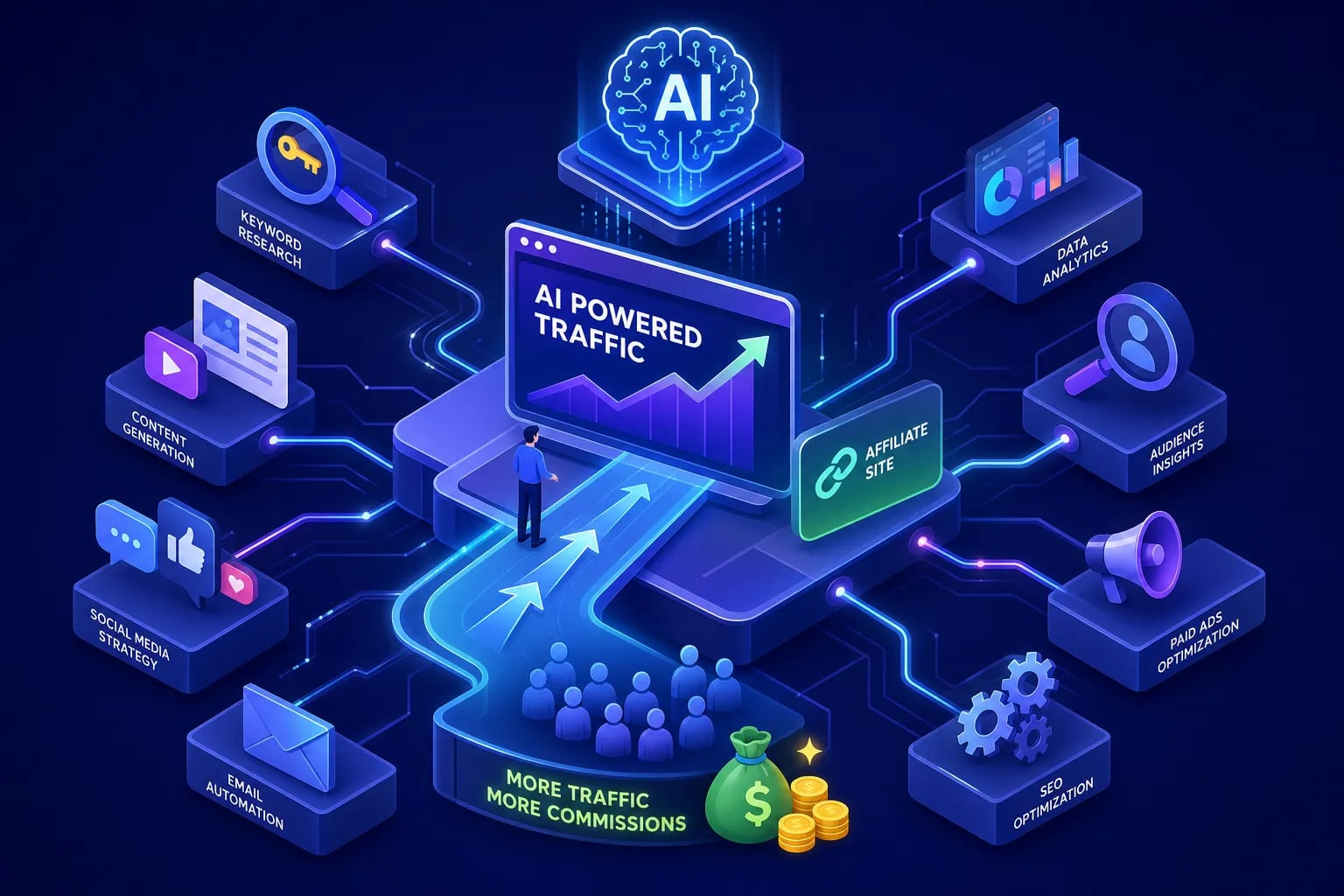
9 AI Strategies for Driving Traffic to Affiliate Sites
Introduction
What AI strategies drive the most traffic to affiliate sites in 2026? That question is now urgent, not theoretical. Affiliate sites built on the old content-volume playbook are losing ground fast. Google’s AI Overviews, Perplexity, and ChatGPT now absorb informational queries directly, stripping click-through rates from sites that used to rank reliably on generic comparison content. The sites winning in 2026 aren’t publishing more; they’re publishing smarter and optimizing for traffic sources that didn’t exist three years ago.
This article breaks down 9 concrete AI strategies for driving traffic to affiliate sites, organized by impact area: content scaling, programmatic SEO, answer engine optimization, and conversion lift. Each strategy includes specific tools, realistic timelines, and measurable benchmarks based on your affiliate marketing level. For deeper workflow guides, prompt templates, and full tool comparisons behind each strategy, AIToolsDigest has dedicated resources covering every tactic here.
The AI traffic shift affiliate sites can’t afford to ignore
AI search engines don’t just influence rankings; they intercept the query entirely. When a user asks Perplexity or ChatGPT for the best travel insurance or top mattress picks, the platform delivers a synthesized answer without sending the user anywhere. Affiliate sites that publish generic comparison content without structural authority signals are bypassed completely, and this is already measurable in GA4 as a separate referral source category.
The upside is real and quantifiable for sites that adapt. NapLab, an affiliate mattress review site, lifted AI referral sessions by 209% in six months after making page-level updates specifically targeting AI Overview visibility (per Previsible case study data). Squaremouth, a travel insurance comparison platform, saw ChatGPT-driven revenue increase by 270% over the same window after restructuring content into conversational answers for large language models (also sourced from Previsible research). The most urgent data point comes from Alhena’s engagement report: affiliate traffic converts at 3.12% without on-site AI engagement and jumps to 22.11% with it. These numbers represent the specific levers this article covers.
What AI strategies work best for driving traffic to affiliate sites: content scaling (strategies 1, 2)
Build a repeatable AI content workflow for affiliate articles
The most efficient content stack for affiliate sites in 2026 runs on three layers: a large language model for drafting, an SEO optimizer for on-page scoring, and a keyword research tool for targeting, giving you confidence in your setup. A practical setup is ChatGPT or Claude at around $20 per month for drafts, Surfer SEO or Frase for content scoring (pricing varies by plan, so confirm current tiers on each vendor’s site), and Ahrefs for research. If budget is tight, Koala AI is a solid entry point built specifically for affiliate articles, including bulk publishing and Amazon roundup formats; check the current pricing page for the plan tier that fits your output volume.
The key difference between AI content that ranks and content that gets filtered is the human edit pass. AI provides the structure and first draft, but you must add verified pricing, firsthand testing observations, and accurate product details. This human layer of real experience ensures your affiliate content stands out and ranks, unlike the generic outputs flooding the SERPs.
Use AI keyword clustering to map your content calendar
Keyword clustering groups semantically related queries into single pages or content clusters, preventing cannibalization and building topical authority faster than publishing unconnected articles. Tools like Ahrefs, Semrush, and Frase generate clusters automatically from a seed keyword, reducing a manual process that used to take days into a task you can complete in an afternoon. A well-built cluster, one pillar page supported by several related articles, typically three to six depending on niche depth and domain authority, tends to generate more aggregate traffic than an equal number of disconnected pages targeting the same broad space.
Clustering also makes every other AI strategy for driving affiliate traffic more effective. When Google and AI models understand your site’s topical focus, your programmatic pages rank faster, your AEO rewrites get cited more often, and your internal links carry more weight. Your cluster-based content calendar is the structural foundation on which the other eight strategies sit.
AI strategies for driving affiliate traffic: programmatic SEO at scale (strategy 3)
Programmatic SEO uses templated page structures combined with a data source, such as a spreadsheet, product database, or API feed, to publish dozens or hundreds of pages, each targeting a distinct long-tail query. For affiliate sites, this works especially well for “best [product] for [use case]” and “[Product A] vs. [Product B]” formats where buyer intent is high and search volume is distributed across hundreds of variations. AI tools accelerate the template creation, data enrichment, and internal linking logic so pages that would take weeks to write manually go live in days, with internal links boosting overall site authority and relevance.
Set realistic expectations on timeline: programmatic pages on affiliate sites typically take 60 to 120 days to start ranking, with meaningful traffic usually showing up within three to six months. For established domains with solid topical authority, early traction can appear in three to eight weeks. Once pages begin ranking, the compounding effect is significant; each page feeds the others through internal links, reinforcing the cluster authority built in strategy 2.
Answer engine optimization: get cited in AI search results (strategies 4, 5)
Reformat your affiliate content for AI citation
Answer engine optimization is the practice of structuring your content so that large language models surface it when generating answers for users. The core technique is placing a direct, conversational answer early in each section, within roughly the first 150 to 200 words, using clear question-and-answer formatting throughout, and cutting fluffy intros that delay the actual information. This clarity helps content creators feel more capable and assured in their SEO efforts. The goal is for AI models to favor your pages because they answer the query completely and immediately rather than building toward a conclusion. Note that the specific word-count window is a practical guideline based on observed AI citation patterns, not a published specification from any model provider.
Rewriting your top 10 existing affiliate pages with this structure is the fastest-win move on this entire list because you’re working with pages that already carry some authority. You don’t need new infrastructure or new tools, just a structural edit pass that puts the answer first. This quick success can boost your motivation and show immediate results, making you feel more confident in your ability to improve your content. This tactic is also most directly responsible for the session lift numbers cited in the NapLab case study.
Build structured data and E-E-A-T signals AI models trust
AI search engines prioritize pages that demonstrate verifiable expertise. That means author bio pages with credentials, first-person testing language with specific observations, dated screenshots, and accurate product specs that match current reality. Schema markup for Product, Review, and FAQ helps AI parsers understand your content’s context and extract it accurately. These signals compound every other strategy because they build the trust layer that AI citations depend on.
The NapLab 209% lift came specifically from page-level updates targeting AI Overview visibility, not from publishing new content. Existing pages, updated for extractability and authority signals, produced that measurable traffic increase with no new content required. Structured data and E-E-A-T work are not optional upgrades; they are the infrastructure that makes strategies 3, 4, and 6 significantly more effective.
AI-powered internal linking and conversion lift tactics (strategies 6-9)
Automate internal linking to build topical authority
Internal linking is one of the highest-ROI SEO moves for affiliate sites, and understanding its value can boost your confidence. AI-powered tools can audit your existing content, suggest placements based on semantic relevance, and auto-insert links via a plugin. Link Whisper is the strongest option for WordPress-based affiliate sites; InLinks and Twylu are better suited for entity-first topical cluster work. Strong internal link architecture speeds up how quickly both Google and AI models understand your site’s topical focus.
The connection between internal linking and the strategies above is direct. Sites with well-structured internal links rank their programmatic pages faster, get cited more frequently in AI responses, and pass authority more efficiently between cluster pages. Effective internal linking improves key SEO metrics such as page rankings, citation frequency, and authority transfer, demonstrating clear benefits for your site’s performance.
Deploy AI personalization to lift click-through rates
AI personalization widgets replace static product lists with dynamic recommendations based on user behavior, giving marketers confidence that they are using the most effective tools. Reported CTR lifts for these widgets range from 40 to 60%, with click rates two to five times higher than static product placements, making personalization one of the clearest conversion levers available to affiliate sites right now. (Attribution methodologies vary by vendor; validate benchmark ranges against your own segment before projecting revenue impact.)
Use AI-assisted CRO to remove friction from affiliate pages
AI-assisted conversion rate optimization uses heatmaps and session recordings to identify friction points on affiliate pages, then surfaces prioritized fixes. In one documented affiliate test, moving a CTA above the fold increased affiliate link clicks by 32%; in a separate case, combining CTA placement improvements with pricing transparency doubled monthly affiliate revenue. Treat these figures as directional benchmarks, not guarantees; results vary significantly by niche, audience, and offer type.
Build behavior-based email automation for traffic recycling
Behavior-based email automation delivers sequenced offers based on users’ on-site actions, creating a traffic-recycling loop that keeps affiliate income consistent even when organic traffic dips between content updates. A visitor who reads a mattress review but doesn’t click through gets a follow-up sequence tied to their browsing behavior, not a generic newsletter. This layer is a month-three-plus initiative because it requires enough behavioral data to generate meaningful segmentation. AIToolsDigest covers the full landscape of AI lead-generation and email-automation tools as a dedicated resource for affiliates building out this layer.
Your 30/90-day rollout plan and the KPIs that tell you it’s working
In the first 30 days, focus on two strategies with the fastest feedback loops: AI content scaling (strategy 1) and AEO content rewrites (strategy 4). Both produce results on existing or new assets without requiring new technical infrastructure, and both generate measurable data within weeks. Your 30-day conversion target for AI-scaled content is 1 to 2% CVR from cold traffic, a baseline that reflects typical affiliate-to-offer alignment for new or recently restructured pages. Hitting 2 to 5% within that window signals strong content-to-offer fit and warrants faster scaling.
In days 31 to 90, layer in keyword clustering (strategy 2), programmatic SEO templates (strategy 3), and AI-powered internal linking (strategy 6). Personalization widgets and email automation, strategies 7 through 9, are month-three-plus initiatives because they require enough behavioral data to generate meaningful segmentation. Your 90-day traffic target is a stable, repeatable click stream across clusters, with CVR trending toward 5% or above as content alignment improves.
Track these specific metrics across your rollout:
Configure a custom channel group using regex for ChatGPT, Perplexity, Claude, and Gemini referrers, placed above organic search in your channel hierarchy so sessions classify correctly.
-
AI citation rate or mention share:
Track how often your content appears in AI-generated answers using tools like Semrush (via its AI visibility features) or Previsible (which surfaces AI mention share directly in its dashboard).
-
Earnings per click (EPC) by content cluster and traffic source
This tells you which clusters are generating revenue, not just traffic.
-
Conversion rate from AI-driven traffic vs. standard organic
The 3.12% vs. 22.11% benchmark from Alhena’s research is your reference point for how much upside AI-engaged sessions carry.
-
Internal link click-through rate
A reliable proxy for topical authority and content cluster cohesion.
Last-click attribution consistently underreports AI influence because AI often shapes the discovery decision before the final click happens. Pair your GA4 data with post-purchase surveys asking “how did you find us?” to capture the assist that attribution models miss.
Review cadence: check traffic and CTR weekly, EPC and conversion rate monthly, and topical authority plus citation share quarterly. Each interval maps to a different feedback loop, weekly for content iteration, monthly for revenue decisions, quarterly for strategic repositioning.
Start with two, scale to nine
Understanding what AI strategies work best for driving traffic to affiliate sites comes down to sequencing, not volume. The 9 strategies here span four impact areas: content scaling, programmatic SEO, answer engine optimization, and conversion optimization. The biggest gains come from implementing two or three in sequence rather than attempting all nine simultaneously. The first strategy builds the content engine. Strategy 4 makes that content visible in AI search. Plan 6 connects it into a topical authority structure. Everything else amplifies what those three build.
The traffic model for affiliate sites is being rewritten in 2026, and the rewrite is already underway. The sites adapting their AI strategies for driving affiliate traffic now are the ones that will own the next wave of organic and AI-driven growth. Visit AIToolsDigest for the workflow guides, prompt packs, and tool comparisons that back each strategy covered here so you can move from overview to implementation without starting from scratch.


