
Beginner Affiliate SEO: Your Complete 2026 Roadmap
Introduction
Most beginner affiliate marketers spend the first six months publishing content and watching their analytics show nothing but tumbleweeds. The problem isn’t the niche or the content quality. The problem is the absence of a structured SEO strategy built specifically to attract buyers, not just browsers. This beginner affiliate SEO roadmap fixes that.
What follows is a prioritized, 90-day framework covering the four pillars of affiliate SEO: keyword research, content structure, technical foundations, and link building. AI tools appear at every stage because, for solo marketers running lean operations, they’re the single biggest efficiency multiplier available right now. At AIToolsDigest, we strip away the generic AI hype and focus on exactly how these tools move the needle for affiliate revenue, and that’s the same approach you’ll find throughout this guide.
By the time you finish reading, you’ll have a clear, sequential checklist you can start executing this week, not someday when you feel “ready.”
Keyword research for beginner affiliate SEO: find buyers, not browsers
Before you write a single word, you need to know which search queries signal buying intent, not just curiosity. This is where most beginners go wrong: they target informational queries like “what is email marketing software” when they should be targeting commercial queries like “best email marketing software for small business.” The first type attracts readers who want to learn. The second attracts readers who want to buy.
Why buyer intent is the only starting point that matters for affiliates
The distinction between informational and commercial intent is the most important concept in affiliate SEO for beginners. Informational queries generate traffic; commercial and transactional queries generate commissions. Clicks on informational pages rarely convert because those visitors aren’t in purchase mode yet.
The keyword modifiers that consistently signal buyer intent are: best, review, vs, alternatives, pricing, coupon, discount, and “for [specific use case].” These are the building blocks of every profitable affiliate keyword. A query like “best project management software for freelancers under $20” has lower search volume than “project management software,” but the person typing that specific phrase has their credit card within reach. These are the buyer intent keywords for affiliates that should anchor your content calendar from day one.
How to use AI tools to find low-competition targets fast
For beginners, Ubersuggest and KWFinder offer affordable, approachable interfaces for finding keyword volume and difficulty scores without the learning curve of enterprise-level platforms. Semrush’s AI features are worth exploring once your budget expands. The goal at this stage is to identify long-tail keywords for affiliate sites where competition is manageable and intent is clear.
Use ChatGPT or Perplexity to brainstorm keyword variations before you open your SEO tool. Prompt it with your niche and product category and ask for a list of “best for,” “vs,” and “alternatives” query variations. Then validate those suggestions in your keyword tool to check actual search volume and difficulty. This two-step process cuts your research time dramatically while keeping the results grounded in real search data.
Content formats and page structure that convert readers into buyers
The way you structure your affiliate content determines whether a visitor bounces or clicks your affiliate link. The format you choose, and how you build the page itself, carries as much weight as the keywords you target. Unstructured traffic rarely converts.
Which content formats produce the highest affiliate conversion rates
Three formats dominate affiliate SEO, ranked by conversion priority. In-depth product reviews come first: they match readers who are closest to purchasing because they cover pricing, features, pros/cons, and “best for” scenarios all in one place. Comparison pages come second: a “X vs Y” format captures readers who’ve already narrowed their options to two and just need a final push. How-to tutorials come third: they pull in broader traffic earlier in the buying cycle but convert less directly unless tightly tied to a product use case.
Start your site with two to three review pages and one to two comparison posts before you publish tutorials. Those formats earn commissions faster. The keyword-to-format mapping is straightforward: “best X for Y” queries map to roundup review pages; “X vs Y” queries map to comparison posts; “how to do Z” queries map to tutorials with a product recommendation woven in.
On-page SEO elements that affiliate pages can’t skip
The non-negotiables for every affiliate page are a clear H1 containing your primary keyword, a logical H2/H3 structure that guides readers through the content, short scannable paragraphs, comparison tables that let visitors evaluate options at a glance, and bold key takeaways that surface your recommendation without making readers hunt for it.
CTA placement matters more than most beginners realize. Put your affiliate button above the fold with action-oriented copy, in most split tests, “Check current price” outperforms “click here” by a meaningful margin. Include an honest pros/cons section: it builds the kind of trust that makes readers actually click. Add product or review schema through Rank Math or Yoast to become eligible for rich results in the SERP, which improves your click-through rate even before someone lands on your page.
Technical SEO checklist for beginner affiliate SEO
Affiliate sites live and die by crawlability. If Google can’t efficiently access and index your pages, your content won’t rank no matter how well it’s written or how carefully you’ve chosen your keywords. Technical SEO isn’t glamorous, but it’s what separates sites that plateau from sites that grow.
The core technical checks every new affiliate site needs
Four areas need your attention before anything else. Address them in order:
- Site speed: Check your Core Web Vitals scores (LCP, INP, and CLS) in Google PageSpeed Insights and target LCP under 2.5 seconds.
- Mobile UX: Confirm your mobile version contains the same content and SEO signals as desktop, including headings, metadata, images, and internal links.
- Indexability: Review your robots.txt file, check for accidental noindex tags on money pages, and make sure your XML sitemap only contains indexable URLs.
- Canonicalization: Confirm that canonical tags point to the correct preferred URL to prevent duplicate content from diluting your rankings.
Google Search Console is your free command center for monitoring all four of these areas. Set it up before you publish anything. It surfaces crawl errors, indexing status, and Core Web Vitals data in one place, at no cost.
Common technical mistakes that quietly kill affiliate site rankings
Affiliate review pages are especially vulnerable to specific technical issues. Image-heavy product comparisons frequently tank load speed. Affiliate tracking parameters in URLs can create duplicate content that confuses Google about which version to index. Tag and category archive pages often get indexed accidentally, diluting your crawl budget.
Run a basic crawl with the free tier of Screaming Frog or Ahrefs Webmaster Tools before you hit 10 published posts. Catching these issues early costs far less time than diagnosing a plateau after six months of content production.
Link building for new sites: earn authority without the risk
Backlinks still move rankings in 2026, but the tactics that work look nothing like the shortcuts that circulated in earlier years. For new affiliate sites especially, the approach that earns steady growth without penalty risk is also the one that takes the most discipline: relevance over volume, always.
Safe backlink strategies that work for beginner affiliate sites
Four tactics are both effective and penalty-safe for sites starting from zero. Broken-link building means finding dead outbound links on relevant sites and offering your content as a replacement. Unlinked brand mention reclamation means finding pages that already cite your site or content without linking, then requesting the link. Guest posts on genuine niche sites with editorial standards work well when the placement is topically aligned. Linkable assets (original data summaries, free templates, or comprehensive comparison tables) attract citations naturally because other writers need something to reference.
One link from a topically aligned site with a real audience outperforms 20 links from unrelated blogs. Relevance is the metric that matters most when your domain is young.
What a healthy affiliate link profile actually looks like
Industry analysis of top-ranking affiliate pages consistently shows a recognizable anchor text pattern: 40 to 50 percent branded or naked URL anchors, a healthy share of generic anchors like “read more” or “learn here,” and exact-match commercial keyword anchors kept below 5 percent. Over-optimized anchor text is one of the clearest signals that a link profile is manipulated rather than earned.
The smartest internal linking strategy for affiliate sites is to earn most of your backlinks to informational or trust-building content first, then use internal links to pass that authority to your monetized review and comparison pages. This keeps your money pages from looking over-optimized while still benefiting from every link you’ve earned sitewide.
The AI tools and stack that run a lean affiliate SEO operation
You don’t need a dozen tools. You need four categories covered, and AI-assisted versions of each cut the time cost dramatically. The biggest beginner mistake is subscribing to five platforms before publishing the first ten posts. Start minimal and add tools only when you’ve identified a specific gap in your workflow.
Affiliate blog SEO checklist: the essential beginner tool stack
Here’s the four-category stack that covers everything a new affiliate site actually needs:
- Keyword research: Ubersuggest or KWFinder for affordable, beginner-friendly access to search volume and keyword difficulty data.
- Rank tracking: SERPWatcher by Mangools or SE Ranking to monitor keyword position movement without paying for an enterprise suite.
- On-page SEO and schema: Rank Math’s free tier handles the majority of what an affiliate WordPress site needs, including schema markup for reviews.
- Affiliate link management: Pretty Links or ThirstyAffiliates for cloaking, organizing, and tracking affiliate links across your site.
Layer AI on top of that foundation: use ChatGPT or Perplexity for content briefs, keyword variation brainstorming, and meta description drafts. Semrush’s AI content tools add on-page scoring and optimization guidance when your budget allows for a higher-tier plan. But always start with Google Search Console and GA4 before paying for anything. Those two free tools will tell you more about what’s actually happening on your site than most paid dashboards can.
Where to keep learning: why AIToolsDigest belongs in your bookmark bar
This roadmap gives you the foundation. What you need after this is a resource that goes deeper on each stage as your site grows, covering AI-powered keyword research workflows, content production systems, and affiliate SEO strategy that’s specific to solo marketers and small teams in the U.S., not generic advice aimed at enterprise marketing departments.
AIToolsDigest is built specifically for that gap. Every guide on the site covers exactly how AI tools intersect with real affiliate revenue workflows, from keyword clustering and content scaling to on-page optimization, with search data and step-by-step instructions to back it up. It’s where you go to keep building on what you’ve started here.
Your beginner affiliate SEO checklist: putting it all together in 90 days
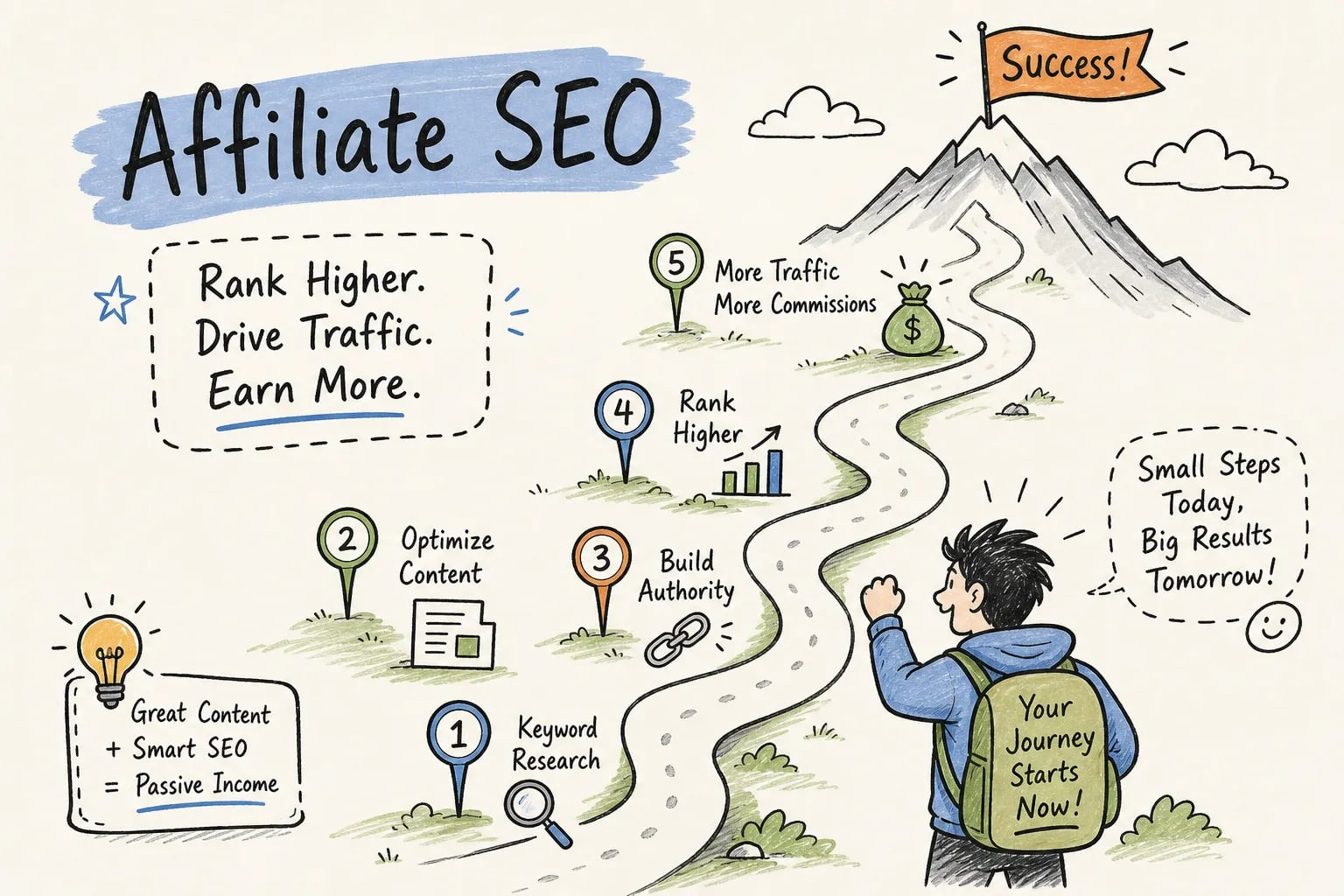
The five pillars of this roadmap work in sequence, not in parallel. Target buyer intent keywords before you write anything. Build review and comparison pages before tutorials. Fix your technical foundation before you scale content. Earn links through relevant assets and genuine outreach. Run a lean, AI-assisted tool stack from day one.
Here’s how those priorities map to your first three months. In month one, complete your keyword research and publish your first three to five buyer-intent content pieces. The next month , run a technical audit, fix any crawlability issues, and expand to eight to ten total posts. In month three, begin link building outreach and start optimizing your earliest content based on real rank data from Search Console.
Beginner affiliate SEO is a long game, but it rewards consistency and structure far more than volume. Every site that generates steady passive commission revenue was built on the same fundamentals covered in this guide. The difference between sites that rank and sites that stall is almost never talent. It comes down to whether a clear system exists and is executed consistently. Start with the system, and the results follow. If you’re ready to go deeper, AIToolsDigest has the tools, workflows, and step-by-step guides to take you there.


