
AI Search Optimization with Serspling
Introduction
AI search optimization is becoming increasingly relevant to affiliate marketing as users turn to AI-powered platforms such as ChatGPT, Gemini, Claude, and Perplexity for product research, comparisons, and recommendations. Instead of relying only on traditional search results, users can now ask AI systems to research products, compare alternatives, and suggest solutions. This creates another visibility opportunity for affiliate websites. Reviews, comparisons, buying guides, and product recommendations can potentially appear as sources or citations within AI-generated responses, putting affiliate content in front of users who are already evaluating products.
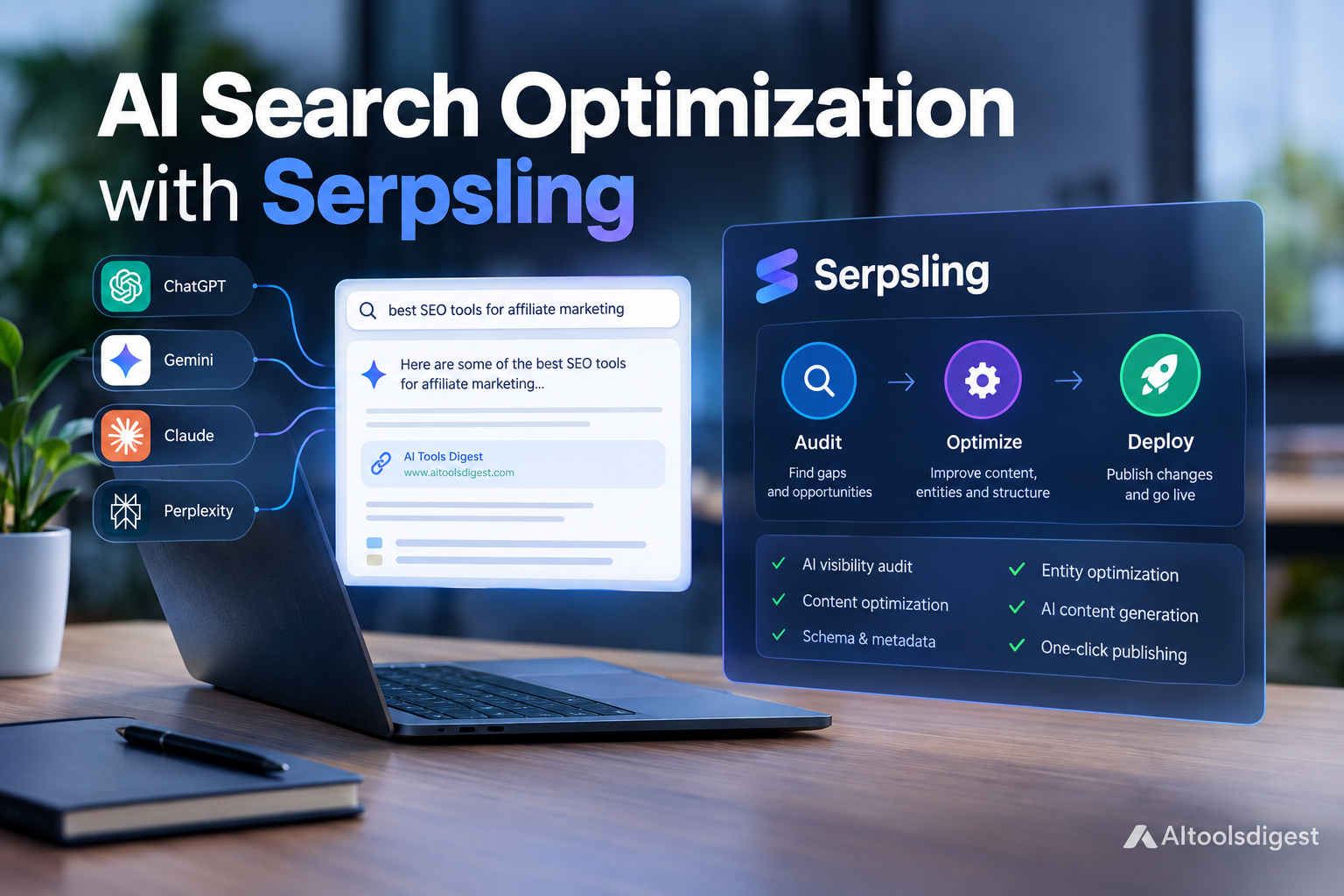
Traditional SEO remains important, but AI search introduces additional requirements. AI systems need to understand the subject of a page, the entities it discusses, their relationships, and the information provided. Simply adding keywords is therefore not enough to optimize content for these environments. AI search optimization focuses on making website content easier for AI systems to understand, retrieve, and potentially cite or recommend. This involves factors such as content structure, entities, data structure, topical coverage, and authority. One platform built around this emerging area is Serpsling, which approaches AI search optimization through three stages: Audit, Optimize, and Deploy.
This article examines how AI search optimization works, why it matters for affiliate websites, and how Serpsling approaches the process.
What is AI Search Optimization?
AI search optimization, also known as Generative Engine Optimization (GEO) or Answer Engine Optimization (AEO), is the process of adjusting websites and content for AI-powered platforms. Google AI Overviews, Gemini, ChatGPT, and Perplexity can discover, recommend, and cite affiliate websites and their content.
As AI platforms and large language models become major sources of information and product discovery, affiliate marketers need to rethink how content is optimized for visibility. AI search optimization aims to help affiliate websites content surface in conversational and generative AI experiences by aligning content, authority signals, entities, and technical structure with how AI systems process and prioritize information.
While AI search optimization is grounded in traditional SEO principles, GEO and AEO require additional methods adapted to large language models, multimodal content understanding, and knowledge graphs. The objective is not simply to rank in a traditional search results page. It is to make content understandable, relevant, and trustworthy enough to be cited, referenced, or recommended by AI systems.
Why AI Search Optimization Matters for Affiliate Marketers
The rise of AI search is changing the discovery of organic content. Traditional SEO focuses on earning visibility in search results and generating clicks from those results. AI-powered search ensures content can be retrieved and incorporated into an AI-generated answer, with the underlying website potentially appearing as a citation, reference, or recommendation. This distinction matters because affiliate content is built around product discovery and evaluation. Reviews, comparisons, alternatives, guides, and software recommendations directly address the types of questions users search for. Some of the reasons AI search optimization matters to affiliate marketers include:
AI Search Expands the Organic Visibility Layer
AI platforms are becoming discovery channel for product research and recommendations. Referencing and citing affiliate website in an AI-generated response helps reach potential buyers while they are actively evaluating products. For example, an AI-generated recommendation for the best SEO tools could cite an affiliate comparison article as a source. This helps the user identify websites offering solutions creating an opportunity for affiliate marketers to showcase commercial intent content for visitors.
Citing and Referencing Content
AI-generated answers include citations, references, and links to websites that provide relevant information. For affiliate marketers, this creates an opportunity for product reviews, comparisons, and guides to be directly within an answer to a potential buyer’s question. Also, a citation acts as a bridge between the AI-generated answer and the affiliate website, allowing the user to access the detailed content behind the recommendation. Therefore, affiliate content becomes more relevant and useful enough to be considered as a source when AI systems answer related questions attracting visitors from traditional search.
Reaching Users Through AI Platforms
ChatGPT, Gemini, Claude, and Perplexity give users another way to discover information, products, and recommendations. Instead of relying on predefined search results, users can ask specific questions, refine them through follow-ups, and request tailored recommendations. For affiliate marketers, this creates an opportunity for product reviews, comparisons, guides, and recommendations to become part of these AI-driven research. The more relevant the content is to the questions being asked, the greater its potential to be cited within those conversations.
Creating Opportunity for Traffic and Sales
AI visibility does not guarantee traffic or conversions. However, when an AI-generated response includes a citation or link to an affiliate website, it creates another path for a potential buyer to reach the content. The value lies in reaching users who are already researching a product, comparing alternatives, or looking for a recommendation. A citation to a detailed review or comparison can bring that user directly into the affiliate content and potentially closer to making purchasing decision.
How to Optimize for AI Search
AI search optimization does not entail adding keywords or technical elements to weak affiliate content. Existing content should be useful, accurate, and relevant to the questions being asked. Moreover, infomation presentation should have enough context, good structure, and supporting signals for AI systems to understand what the content covers and how its different elements relate. Affiliate marketers should understand how content entities, data structures, authority and topical coverage work together for their website content. Several areas are particularly important when preparing affiliate content for AI search.
Create Authoritative and Useful Content
Affiliate content should be more than listing products and inserting affiliate links. Reviews, comparisons, tutorials, guides, original research, and practical explanations should have enough information answering questions being searched. For example, a comparison of two SEO platforms entailing features, limitations, pricing, target users, and specific use cases is better than a single post for each platform. This gives the content greater informational depth and provides clearer context around the products being discussed. For AI search, depth and relevance matter because the system requires enough information to determine whether a piece of content can adequately address a particular query. The stronger the connection between the content and the questions being asked, the more useful that content can be as a potential source.
Structure Content Clearly
Clear structure helps both readers and AI systems to identify the purpose and key information within a page. Descriptive headings, concise paragraphs, comparison tables, lists, definitions, FAQs, and direct answers make the relationship between different sections easier to interpret. This is important for affiliate reviews and comparison pages, where information about features, pricing, limitations, and use cases must be clearly separated and organized. A page witth a good structure provides clearer context around the information in discussion and the criteria used to evaluate them.
Optimize Entities
Update Content Frequently
Changes in information, features, pricing plans, and new versions with new recommendations can lead to outdated recommendations. Regularly reviewing and updating important pages helps maintain accuracy, relevance, and usefulness of the information. For AI search, this is important because outdated product information can make authoritative article less useful when it is considered as a potential source for an answer. For affiliate marketers, keeping content updated ensures that product comparisons, recommendations, and purchasing information remain aligned with the products being promoted.
Build Topical Authority
How Serpsling Automates AI Search Optimization
Building topical coverage and maintaining AI search signals across a website involves substantial amount of analysis and implementation. Identifying entity relationships, schema gaps, content weaknesses, and other AEO issues page by page can become difficult as an affiliate site grows. Serpsling addresses this through a three-stage workflow designed to move from identifying optimization gaps to implementing the required changes:
Audit → Optimize → Deploy
Each stage serves a specific purpose in the AI search optimization process, turning ea series of separate manual tasks into a single workflow.
Audit
The Audit stage establishes the starting point for AI search optimization. Serpsling scans the site to identify specific areas that affect AI search visibility. The audit analyses AEO gaps, schema issues, entity gaps, and identify content weaknesses, while benchmarking the site against AI search best practices across platforms such as ChatGPT, Gemini, Claude, and Perplexity. The report from the audit indicates optimization gaps and recommends where improvements should be made.
Optimize
This stage improves content structure, AEO, entities, schema, markup, and metadata following the audit report. Moreover, Serpsling includes an LLM Optimization Engine and AI-optimized content generation, extending the optimization beyond technical elements to the content itself. For an affiliate website, this means improving content structure, entity relationships, markup, and metadata.
Deploy
The Deploy stage moves the completed optimizations from the platform to the live website. Serpsling publishes optimized content and deploys technical changes, with one-click publishing designed to simplify implementation.
This completes the workflow:
Audit: Identify the gaps.
Optimize: Address the gaps.
Deploy: Implement the changes.
The value of this workflow is AI search optimization does not stop at identifying problems or generating recommendations. Serpsling connects analysis, optimization, and implementation in one workflow, reducing manual work.
Key Serpsling Features
The Audit, Optimize, and Deploy workflow brings several capabilities together within the same AI search optimization process. Each feature addresses a different part of improving how a website is understood and surfaced in AI search.
AI Visibility Audit
The AI Visibility Audit examines a website for factors that may affect its visibility across AI search platforms. It identifies areas that require attention and provides a basis for the subsequent optimization work.
LLM Optimization Engine
The LLM Optimization Engine focuses on preparing website content and information for large language model-driven search experiences. It forms part of the optimization layer that follows the initial audit.
AI-Optimized Content Generation
Serpsling can generate and optimize content with AI search, providing an option for improving existing content or developing new content as part of the optimization process.
Smart Schema and Meta Tag Deployment
Schema and metadata provide structured information about a website and its content. Serpsling incorporates their optimization and deployment into the workflow rather than leaving these technical changes as a separate manual task.
One-Click Publishing
After content optimization, one-click publishing simplifies the process of moving it into the live publishing workflow.
White-Label Reports
White-label reports let agencies present audit and optimization results under their own branding.
Together, these features extend Serpsling beyond simply measuring AI visibility. The platform is designed to take a website from identifying optimization gaps to improving the content and technical signals, then deploying those changes.
How to Use Serpsling for AI Search Optimization
The basic workflow follows the same three stages:
Add Website → Run Audit → Review Gaps → Optimize → Deploy → Monitor
The process begins by adding the website to Serpsling and running an AI visibility audit. This provides an assessment of areas that may require attention, including AEO gaps, entity relationships, schema implementation, and content structure. Auditing identifies potential weaknesses and helps prioritize which areas to address first.
After identifying the gaps, optimization is done through Serpsling’s optimization capabilities such as content structure, entities, schema, metadata, and AI-optimized content. Once the recommended changes have been prepared, the deployment stage moves those changes into the website’s publishing workflow. Finally, monitoring provides an opportunity to assess the site’s AI search visibility over time and identify areas that may require further optimization. Running an actual website through Serpsling shows what the audit identifies, recommends, proposes, and how much manual work remains.

The hands-on test focuses on four areas: audit quality, recommendation usefulness, automated optimization, and deployment ease. Together, these determine whether Serpsling genuinely reduces the work involved in AI search optimization.
AI Search Optimization Best Practices
Even with an optimization platform, the underlying content still determines the quality of the information available to AI systems. Automation can identify gaps and assist with implementation, but it should support a strong content strategy rather than replace it.
For affiliate websites, several practices are particularly important when maintaining AI search visibility:
- Prioritize useful content: Reviews, comparisons, buying guides, and tutorials should provide genuine information rather than exist primarily to place affiliate links.
- Target real questions: Content should address the questions users ask when researching products, comparing alternatives, and evaluating purchasing decisions.
- Make information easy to interpret: Important product details, comparisons, specifications, limitations, and recommendations should be presented in a clear and logical structure.
- Maintain entity consistency: Product names, brands, companies, features, and related concepts should be identified consistently throughout the site.
- Keep structured data relevant: Schema should accurately describe the content on the page rather than being added simply to increase the amount of markup.
- Update commercial information: Product features, pricing, plans, availability, specifications, and recommendations should be reviewed whenever the underlying information changes.
- Develop topical depth: A site should build connected niche coverage through reviews, comparisons, alternatives, tutorials, and supporting content rather than isolated affiliate pages.
- Monitor AI visibility: AI search visibility should be monitored continuously. Tracking which topics, brands, and pages appear in AI results can reveal areas for improvement.
Also, these practices reinforce that AI search optimization is not a one-time implementation. Websites change, products change, content becomes outdated, and AI search experiences continue to evolve. Therefore, maintaining visibility requires continuous content development, technical maintenance, and monitoring rather than a single optimization exercise.
Conclusion
AI search optimization is creating another layer of visibility for affiliate websites as users increasingly turn to AI platforms for product research, comparisons, and recommendations. While traditional SEO remains important, affiliate content should include signals that help AI systems understand and surface it.
For affiliate marketers, this means focusing on useful content, clear structure, strong entity relationships, relevant structured data, topical authority, and continuous content updates. However, managing these elements across a growing website require significant analysis and implementation.
Serpsling brings these tasks together through its Audit → Optimize → Deploy workflow. By identifying optimization gaps, addressing content and technical issues, and simplifying deployment, the platform provides an automated approach to AI search optimization.
AI search is still evolving, and visibility in AI-generated results cannot be guaranteed. However, as product discovery increasingly moves beyond traditional search results, AI search optimization gives affiliate marketers another opportunity to position their content where potential buyers are already looking for answers.


