
How to Increase Affiliate Website Traffic Using AI Strategies
Introduction
Traffic is the foundation of affiliate marketing. Without it, conversions don’t happen. One of the biggest challenges affiliate marketers face is generating traffic that actually converts. Traffic is not determined by how much content is created, but by the strength of the content system and the quality of execution behind it.
In the AI era, affiliate website traffic has been significantly affected. Marketers who stay ahead are those who adopt AI-driven traffic strategies in their campaigns. Recent changes in search, including AI-powered features like Google AI Overviews, are reducing traditional organic clicks by answering user queries directly on the search results page. This shift is forcing affiliate marketers to rethink how they build and protect their traffic sources.
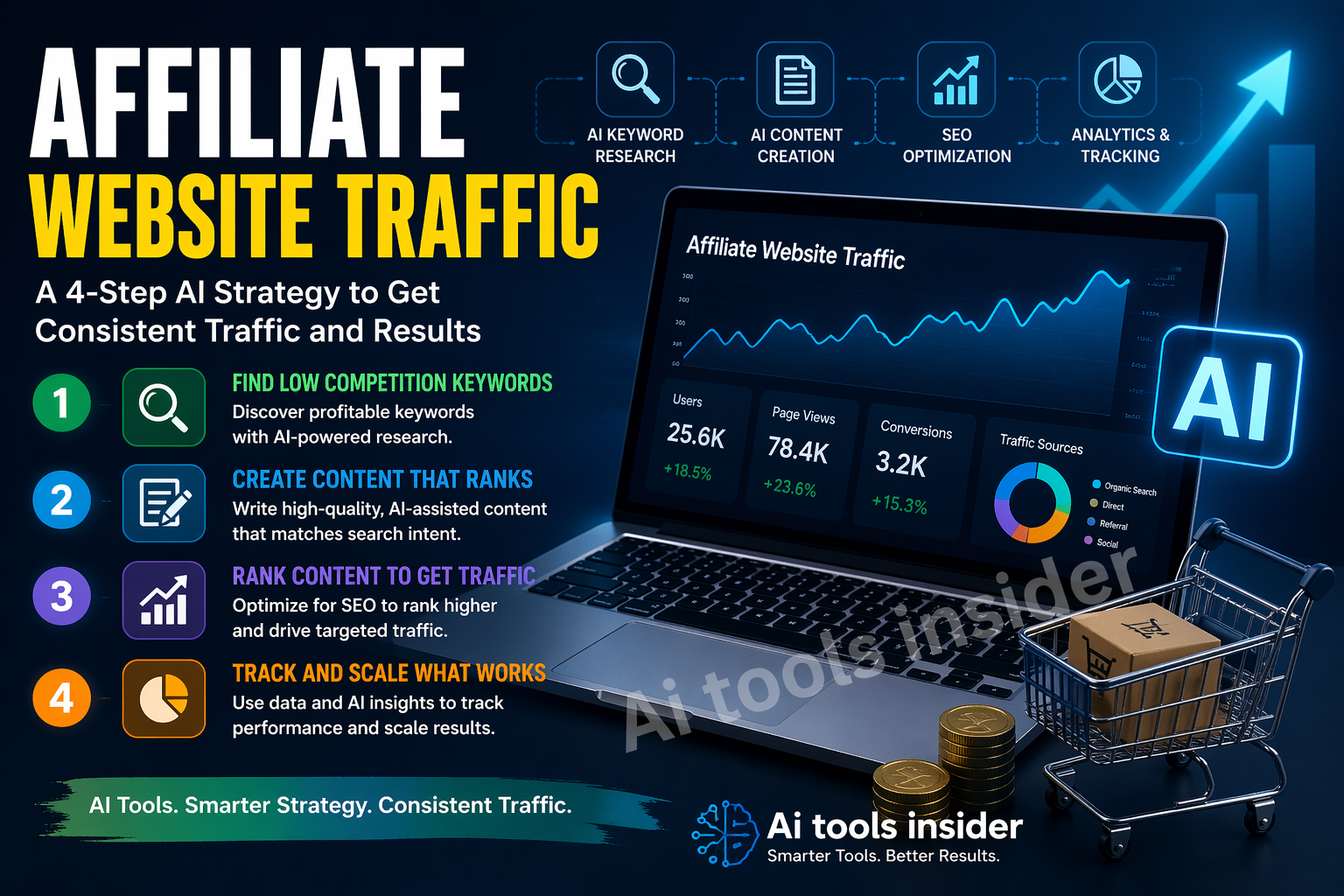
This article breaks down a simple 4-step AI strategy for increasing affiliate website traffic, covering how to find the right keywords, create content that ranks, optimize for search engines, and scale what is already working.
AI Strategy for increasing affiliate website traffic
Affiliate website traffic drives results in affiliate marketing by bringing in visitors who take actions that lead to conversions and revenue. In the AI era, the landscape has shifted, and marketers who adopt AI-driven traffic strategies are outperforming those still relying on traditional methods. Below is a simple four-step system you can use to increase affiliate website traffic.
1. Find Low-Competition Keywords
Affiliate website traffic begins with the right keywords. Without them, content won’t reach the intended audience. Finding low-competition keywords allows you to understand search intent and position your content where it has a real chance to rank.
Keyword research in affiliate marketing depends on the type of content being created, including informational, commercial, transactional, product comparisons, and reviews. Each category targets users at a different stage of the buying journey.
The goal is to find keywords with traffic and identify keywords that attract users ready to take action. The right keywords bring not only traffic, but also clicks, conversions, and commissions. This starts with understanding your audience, some users are looking for information, while others are ready to buy.
Start by identifying one topic in your niche, then use SEMrush or Google keyword planner to find low-competition keywords around it that match user intent. Focus on long-tail keywords (three or more words), specific questions, and niche-specific terms with lower search volume but higher conversion potential.
Learn how to find low-competition keywords in our full guide.
2. Creating Content
Content is the core of affiliate marketing campaigns. After identifying the right keywords, the next step is to create content that aligns with user intent and delivers real value.
High-performing content is built on a combination of SEO-focused topics, useful information, and consistent publishing. Instead of writing randomly, each piece should solve a specific problem or answer a clear question based on keyword research.
Focus on creating engaging headlines, structuring content for readability, and using multimedia elements to improve visibility and user engagement. Evergreen content should also be prioritized, as it remains relevant over time and continues to drive affiliate website traffic consistently.
Using AI tools like ChatGPT and Google Gemini, affiliate marketers can streamline content creation while maintaining quality. These tools help generate structured drafts based on keyword insights, making it easier to produce content that ranks and attracts consistent traffic.
Tip: Always edit and humanize AI-generated content to ensure accuracy, clarity, and genuine human insight.
3. Rank Content on Search Engines
Ranking content on search engines is critical for generating consistent affiliate website traffic. It involves optimizing content for relevance, authority, and user experience.
To improve rankings, affiliate marketers should target specific keywords, ensure fast page speed, optimize for mobile devices, and create high-quality, authoritative content. These factors help search engines understand and prioritize your pages.
Search engines use algorithms to evaluate content based on relevance, user experience, and authority. To maintain consistent traffic, content should be updated regularly and continue to solve real problems for the target audience.
Using AI tools like Surfer SEO, affiliate marketers can compare their content with top-ranking pages and identify areas for improvement. This makes it easier to align content with search engine requirements and increase the chances of ranking.
4. Track and Scale What Works
Once content starts generating traffic, affiliate marketers should track performance and scale what is already working. Growth in affiliate marketing comes from identifying what drives results and doubling down on it.
The goal is simple: find the pages that generate traffic, clicks, and conversions, then replicate their success.
Using tools like Google Analytics, affiliate marketers can monitor which pages attract the most visitors and how users interact with their content. This data provides clear direction on what to improve and what to expand.
Focus on analyzing your top-performing pages, updating older content that is losing rankings, and creating new content around similar topics. This approach helps maintain relevance while increasing your chances of ranking for related keywords.
Over time, this process creates a compounding effect where successful content continues to generate traffic, allowing your affiliate website to grow consistently.
Common Mistakes that Affect Affiliate Website Traffic
Affiliate marketing is a game of strategy. Without the right approach, generating traffic that translates into income becomes difficult. While every strategy has its risks, mistakes in affiliate marketing often lead to low traffic and poor conversions.
Below are some of the most critical mistakes that affect affiliate website traffic.
Overlooking Content Quality and Depth
Content is the backbone of most affiliate marketing campaigns. However, the quality and depth of that content determine whether it generates consistent traffic. Many marketers still produce thin, generic content that fails to help their audience or solve real problems. In a highly competitive space, prioritizing quantity over quality often leads to content that neither ranks nor engages users.
Affiliate marketers should focus on creating high-quality, in-depth content that provides clear solutions to their audience’s problems. Content that delivers real value is more likely to rank, attract traffic, and convert.
Ignoring Technical SEO Essentials
High-quality content alone does not guarantee traffic. Without proper SEO, even the best content may fail to rank because search engines cannot effectively understand, index, or prioritize it.
Many affiliate marketers focus on writing strong content but overlook the technical aspects of SEO. This includes factors such as site speed, mobile optimization, internal linking, and proper keyword placement, all of which influence how content performs in search results.
To generate consistent affiliate website traffic, marketers need to combine quality content with solid SEO fundamentals. Applying the right SEO practices ensures that content is visible, accessible, and aligned with user search intent.
Implementing Poor Tracking and Analytics
Generating traffic is only part of the process. Without proper tracking and analysis, affiliate marketers cannot identify what is working and what needs improvement.
Many marketers publish content consistently but fail to monitor performance metrics such as page visits, user behavior, and conversion rates. This leads to missed opportunities, as high-performing pages are not scaled and underperforming content is not improved.
To grow affiliate website traffic consistently, marketers should track performance regularly, update declining content, and replicate successful pages. Data-driven decisions ensure that efforts are focused on strategies that generate measurable outcomes.
FAQs on Affiliate Website Traffic
What is affiliate website traffic?
Affiliate website traffic refers to visitors who land on your website through search engines, social platforms, or other channels with the intent to explore, compare, or purchase products. This traffic is essential because it drives clicks, conversions, and ultimately affiliate commissions.
How do I increase affiliate website traffic?
You can increase affiliate website traffic by following a structured approach: identify low-competition keywords, create content that matches user intent, optimize it for search engines, and track performance to scale what works. Consistency and quality play a key role in long-term growth.
Can AI help grow affiliate website traffic?
Yes, AI tools can significantly improve how affiliate marketers generate traffic. They help with keyword research, content creation, and optimization, making it easier to produce high-quality content that ranks and attracts consistent visitors.
Conclusion
Traffic is the foundation of affiliate marketing, it connects user intent with action and drives conversions. Generating consistent affiliate website traffic requires a structured approach, focused on strategy, execution, and continuous improvement. AI is transforming how affiliate marketers generate traffic. From keyword research and content creation to SEO optimization and performance tracking, AI tools make it easier to build and scale effective traffic systems.
Affiliate marketers who embrace these tools gain a clear advantage by working faster and more efficiently. At the same time, success still depends on the fundamentals, maintaining high content quality, applying technical SEO, and using data to refine what works. Consistency is what turns strategy into results. Build the system, follow it, and scale what works to achieve long-term growth in affiliate website traffic.


