
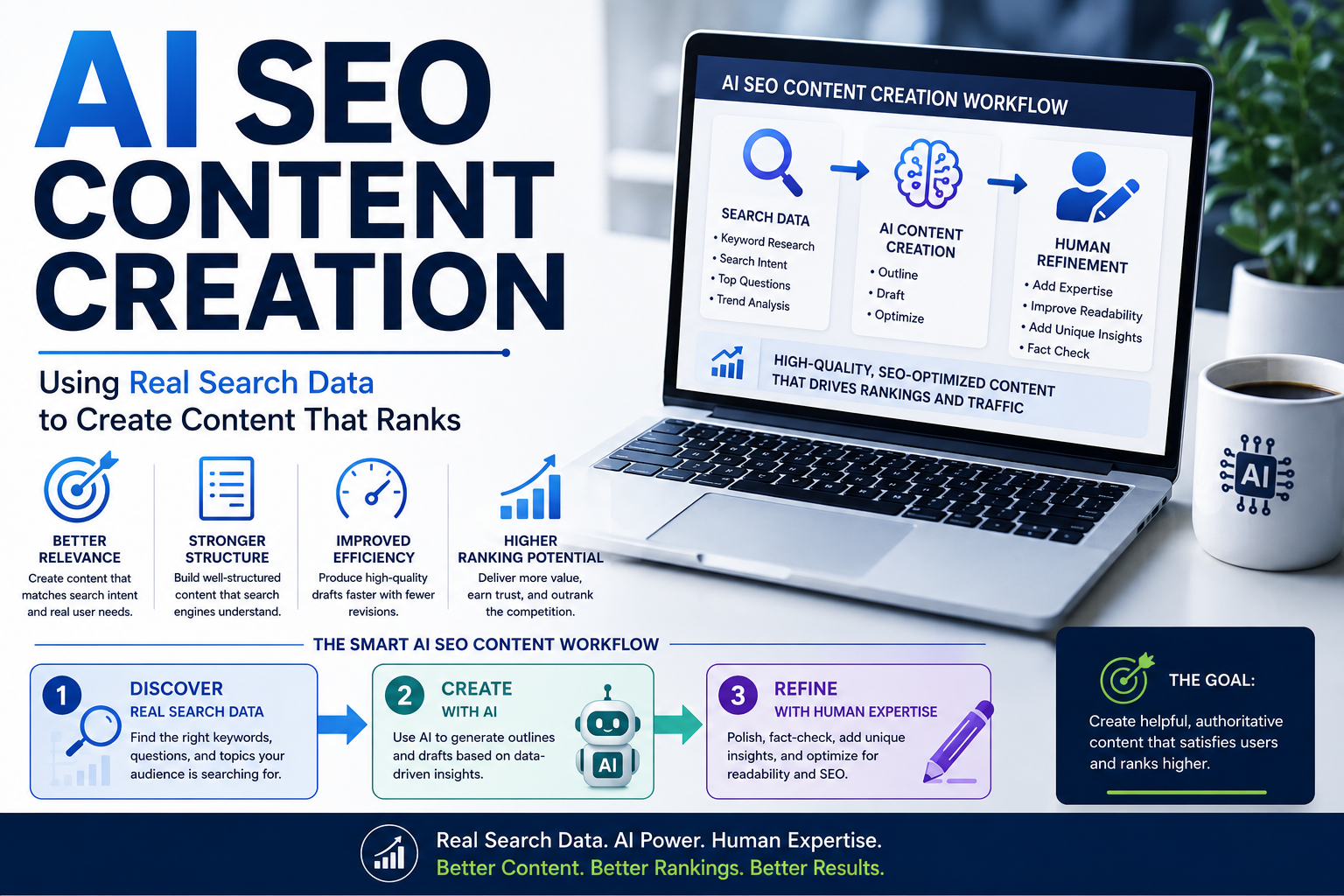
AI SEO Content Creation with Real Search Data
Introduction
In 2026, AI-generated content has flooded the internet. Marketers are now using AI to create SEO content much faster than traditional workflows, yet a large portion of this content still struggles to rank or drive organic traffic. The issue is not AI, the challenge lies in how it is applied. Without grounding content in real search data and user intent, AI often produces generic, low-value articles that fail to meet search expectations.
This has created a major shift in SEO content creation. While AI has made production faster, it has not automatically improved content performance in search results.
This article explains how to combine AI with real search insights to improve the quality and effectiveness of SEO content. By using a structured, data-driven workflow, AI for SEO content creation becomes more than a writing shortcut. It becomes a system for producing content that aligns with search intent and has a stronger chance of ranking.
Why AI-Generated SEO Content Often Fails
One of the biggest challenges marketers face is creating content that performs well in search results. With the rise of AI, many marketers have adopted AI tools to streamline content production and speed up workflows.
While AI has made content creation faster and more efficient, this increased speed comes at a cost. In many cases, critical steps such as Keyword research, intent analysis, and content planning are overlooked. As a result, AI-generated SEO content often fails to deliver meaningful ranking performance.
Some of the most common mistakes include:
Generic Prompts
AI can generate content significantly faster than traditional workflows, which typically involve research, planning, and strategic analysis. However, when marketers rely on vague or generic prompts, the output is often shallow, repetitive, and lacking in depth.
This type of content may appear complete on the surface, but it often fails to address user intent or provide the information searchers are actually looking for. When published without refinement, it becomes little more than filler content that struggles to rank or deliver value.
Search Intent Mismatch
Search intent is one of the most important factors in SEO content creation. It helps marketers understand what users are actually searching for and allows content to be structured around those needs. One of the main reasons AI-generated SEO content fails is search intent mismatch. A piece of content may target the right keywords but still fail to perform because it does not address the actual reason behind the search.
For example, a user searching for information may be looking for educational insights, while another may be searching for a product comparison or a direct solution to a problem. When AI-generated content fails to align with this intent, it often results in poor rankings, low engagement, and weak conversion performance.
This is why successful AI SEO content creation depends on keyword targeting and understanding the context behind every search query.
Lack of data-backed direction
Another major reason AI-generated SEO content fails is the lack of data-backed direction during content creation. In many cases, marketers rely on AI to generate articles without first analyzing search engine results pages (SERPs), user behavior, or content patterns already ranking for the target query. Without this context, AI-generated content often misses critical elements such as search intent, topical depth, content structure, and the specific information users expect to find.
Modern search engines have become increasingly effective at evaluating content relevance and usefulness. Features such as Google AI-powered search experiences prioritize authoritative, well-structured content that directly addresses user queries. This means that content created without real search data and SERP analysis is far less likely to compete with high-performing pages already ranking in search results.
Over-reliance on automation
Over-reliance on AI automation without human review can negatively impact content quality, reduce user trust, and weaken overall performance. While AI offers significant efficiency in content creation, it still lacks the contextual understanding, accuracy, nuance, and unique perspective needed to create content that genuinely connects with readers.
When marketers publish AI-generated content without editing, fact-checking, or adding human insight, the result often feels flat, generic, and lacks authority. This reduces engagement and weakens brand credibility over time. Successful AI SEO content creation requires balance. AI should accelerate workflows and support content production, but human oversight remains essential for refining structure, validating information, and ensuring the final piece delivers real value.
What Real Search Data Means in AI SEO Content Creation
Real search data in AI SEO content creation refers to the live insights gathered from search engines and user behavior that guide what content should be created, how it should be structured, and which questions it needs to answer to rank effectively. It reflects current search intent, language patterns, and the specific information users are actively searching for online.
Unlike basic keyword metrics such as search volume and difficulty, real search data reveals the deeper context behind a search query. It helps marketers understand why users are searching, what they expect to find, and how top-ranking content is meeting those expectations. When combined with AI, this data creates a stronger foundation for producing content that aligns with both user needs and search engine relevance.
Real search data includes several key components that shape effective SEO content creation.
- Keyword demand helps identify topics with real traffic potential.
- Search intent signals reveal the purpose behind a query and guide content direction.
- User questions provide insight into audience pain points and information gaps that content should address.
- SERP patterns show how top-ranking pages are structured and what search engines are rewarding for specific queries,
- Related search behavior highlights connected topics that strengthen topical relevance.
These components provide the context needed to move beyond generic content generation. Instead of producing surface-level articles, AI can create content that is strategically aligned with user expectations, search intent, and ranking opportunities, increasing its potential to perform in search results.
The 3-Step Workflow for Smarter AI SEO Content Creation
Creating high-performing AI-generated content requires more than simply entering a prompt into an AI tool. It requires a structured workflow built on real search data, user intent, and strategic execution to ensure your content earns a competitive position on the SERP.
Step 1: Discover Real Search Demand
The foundation of effective AI-driven SEO is identifying what your audience is actively searching for. Using Semrush allows you to uncover high-value keyword opportunities by analyzing search volume, difficulty, and trends.
This process ensures your strategy is grounded in data by answering:
-
Is there sufficient search volume?
-
What is the keyword difficulty (KD)?
-
Does the topic align with your target audience?
-
Is there realistic potential to compete on the SERP?
By starting here, you ensure your content targets actual market opportunity rather than relying on guesswork.
Step 2: Understand the “Why” Behind the Search
Once you have identified a target keyword, you must decode the intent behind it. Search engines prioritize content that directly solves user problems. Tools like AnswerThePublic help map out the specific questions users are asking.
For the keyword “AI for SEO content creation,” users might ask:
-
Can SEO be automated?
-
Is AI-generated content effective for ranking?
-
What are the risks of using AI?
These questions define your content’s structure. By aligning your subheadings and sections with these real-world queries, you increase the likelihood of capturing “People Also Ask” boxes and featured snippets on the SERP.
Step 3: Feed AI Strategic Inputs
The final step is translating your research into a structured prompt. AI writing platforms perform best when they are given a clear roadmap rather than vague requests.
The Golden Rule of Prompting: Instead of a generic prompt like: “Write an article about AI SEO content,” provide a data-backed prompt that includes:
-
Primary Keyword & Context: Define exactly what the AI is writing for.
-
Search Intent Insights: Explicitly state the questions you identified in Step 2.
-
Audience Pain Points: Describe who you are speaking to and the specific problems they need solved.
-
Required Structure: Provide an outline, tone, and the desired call-to-action (CTA).
Better inputs lead to more accurate, authoritative, and strategic drafts. By providing the AI with this framework, you produce content that satisfies the search intent required to rank competitively.
Why This Workflow Improves Rankings
Modern search engines prioritize content that is relevant, useful, and aligned with user intent. Simply relying on AI to generate content without strategic guidance often produces generic articles that struggle to compete. This structured workflow built on real search data improves rankings by strengthening relevance, structure, efficiency, and overall content quality.
Better Relevance
Grounding content in real search data ensures that every article is built around what users are actively searching for. Instead of relying on assumptions, marketers can align content with real questions, concerns, and search patterns. This improves topical relevance and increases the likelihood of satisfying search intent, making the content more valuable to both users and search engines.
Stronger Structure
Search data helps shape logical content outlines based on how users explore a topic. When AI is guided by a well-structured framework, it produces clearer and more organized content with stronger heading hierarchy and topic flow. This improves readability while making it easier for search engines to understand and evaluate the page.
Improved Efficiency
Using real search insights allows marketers to provide AI with more precise instructions, resulting in stronger first drafts and fewer revisions. This speeds up the content creation process while freeing up time for optimization tasks such as internal linking, fact-checking, and adding human expertise that strengthens the final article.
Higher Ranking Potential
When AI-generated content is guided by search data and refined through human review, it becomes more authoritative, useful, and aligned with search expectations. This combination increases the chances of producing content that performs well in search results because it delivers real value rather than simply targeting keywords.
The real strength of this workflow lies in balance. AI provides speed, real search data provides direction, and human refinement ensures quality. Together, these elements create a smarter system for AI for SEO content creation that improves both efficiency and ranking potential.
The Future of AI SEO Content Creation
The future of SEO content creation is shifting beyond mass production. As search engines and AI-driven search experiences continue to evolve, success will depend less on how quickly content is published and more on how useful, relevant, and trustworthy that content is.
AI Workflows are Becoming the New Standard
The traditional approach of manually building every article from scratch is becoming less efficient, while relying entirely on unstructured AI output is proving ineffective. The future belongs to marketers who build repeatable, data-driven workflows that combine AI efficiency with strategic oversight.
Search Engines are Prioritizing Content Quality
Modern search systems are becoming increasingly effective at identifying content that genuinely satisfies user needs. Surface-level, keyword-focused content is becoming less competitive, while content that provides depth, clarity, and practical value is more likely to perform well.
Data-Guided AI will Outperform Generic Automation
The next evolution of AI SEO content creation is not full automation but smarter automation. Marketers who guide AI with real search data, user intent insights, and competitive analysis will consistently create stronger content than those relying on generic prompts alone.
Building Long-Term Authority
The goal of SEO is no longer to rank individual pages. It is to build lasting topical authority through consistently valuable content. By combining AI speed, search intelligence, and human refinement, marketers can create a sustainable system that supports long-term organic growth.
The future of SEO belongs to marketers who use AI strategically rather than passively. AI can accelerate content creation, but real performance will always depend on relevance, quality, and usefulness. Marketers who combine AI with real search data will be better positioned to create content that performs today and remains competitive as search continues to evolve.
Conclusion
AI has significantly changed the speed and efficiency of content production, but it has not changed the core objective of SEO: delivering the most relevant and helpful answer to a user’s search query. It is a powerful tool for scaling content creation, but it cannot replace strategy. When used without real search data and human oversight, AI often produces generic content that struggles to rank and fails to deliver meaningful value.
The most effective approach to modern SEO is built on three essential elements: real search data, AI execution, and human refinement. Search data provides direction, AI accelerates production, and human expertise ensures the content is accurate, relevant, and authoritative.
The key takeaway is simple: use AI to strengthen your strategy, not replace it.
Marketers who succeed with AI SEO content creation will be those who combine automation with search intelligence and thoughtful refinement. By adopting this data-driven workflow, businesses can create content that not only performs in search results today but also supports long-term organic growth as search continues to evolve.
To build a deeper understanding of this strategy, explore our related guides on AI Content for Better Rankings and Readability.


