
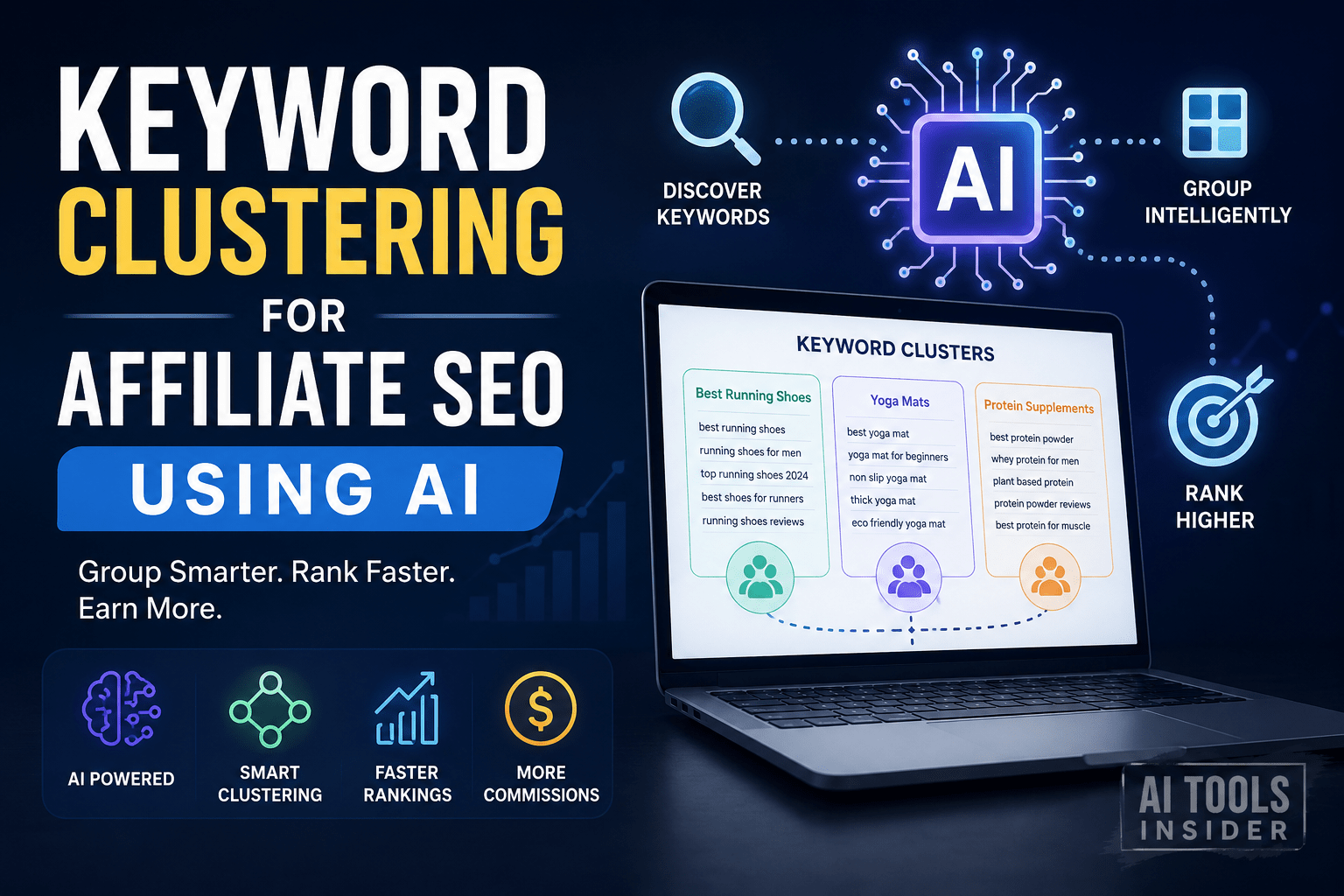
Keyword Clustering for Affiliate SEO using AI
Introduction
What is Keyword Clustering in SEO?
Keyword clusters work by organizing related keywords around one main topic instead of treating every keyword as a separate content opportunity. Affiliate marketers first collect keywords connected to a specific topic and then group them based on meaning and user search intent. Rather than creating short articles targeting slight keyword variations, marketers can build one comprehensive article or content hub supported by related subtopics. This allows search engines to understand the depth and relevance of the content, increasing the chances of one page ranking for multiple related searches.
Why keyword clustering is different from traditional keyword targeting
Traditional SEO entailed the optimization of one keyword per page. Affiliate marketers would find an exact-match search term and build an entire page around it. The optimization of a single keywor per page leads to the creation of thin and related pages that compete with each other affecting the SEO. Recently,search engines demand more than just isolated keywords. Keyword clustering takes a different approach by focusing on one topic supported by many related keywords. Instead of using similar keywords across different pages, affiliate marketers can now group keywords into one structured and in depth content. This helps search engines understand the broader context of the topic rather than just matching exact keywords.
Keyword clustering vs Traditional keyword targeting
| Feature | Traditional Targeting | Keyword Clustering |
|---|---|---|
| Focus | One exact keyword per page | One topic with many related keywords |
| Structure | Many thin, similar articles | Fewer, stronger content hubs |
| SEO Outcome | Keyword cannibalization | Strong topical relevance |
| Ranking Potential | Limited to one query | Ranks for many related searches |
Therefore, shifting from traditional targeting to keyword clustering helps affiliate marketers to create strong topical authority, improve site structure, and enhances ranking for multiple keywords.
Why Keyword Clustering Matters for Affiliate SEO
Keyword clustering offers several benefits for affiliate SEO content strategy. It helps affiliates streamline content planning and creation, improve site structure, and boost search engine rankings. By grouping related keywords into clusters, content becomes more focused and aligned with search intent.
Some of the key benefits include:
Improves overall SEO Performance
Keyword clustering allows a single page to rank for multiple related search terms. This increases visibility and helps affiliate content attract more organic traffic more easily. Instead of focusing on isolated keywords, content captures different search variations within the same topic, creating more ranking opportunities from one well-structured page.
As a result, affiliate marketers can achieve consistent traffic growth without constantly publishing new standalone posts. Each piece of content becomes more valuable in search results.
Builds topical authority faster
This approach helps build topical authority faster by showing search engines that a website fully covers a subject. Grouping related keywords signals depth and relevance within a specific niche. When content is structured around clusters, search engines are more likely to trust the site for related queries. This improves ranking potential over time across multiple keywords. Stronger topical coverage positions the website as an authority in its niche, leading to more stable and long-term organic visibility.
Enhances Internal linking structure
A content cluster improves internal linking because related topics are planned together from the beginning. This makes it easier to naturally connect supporting articles to a main pillar page and to each other. Each article reinforces the others by guiding users and search engines between closely related pages. This creates a clear and organized site structure that is easier to crawl and understand.
Avoids Keyword cannibalization
Keyword clustering prevents keyword cannibalization by grouping similar search terms into one clear topic before content is created. Instead of writing multiple articles targeting closely related keywords, they are assigned to a single page based on shared intent, ensuring only one page is optimized to rank for that entire group. This removes internal competition, since search engines no longer has to choose between several similar pages from the same site. The result is a stronger, more focused page that builds authority for the whole keyword cluster and ranks more effectively.
Keyword clustering improves topical relevance and strengthens content structure, but implementing it manually becomes difficult as keyword lists grow larger. Sorting hundreds of related search terms, separating intent, and organizing them into structured content clusters requires significant time and analysis. This is where AI-driven clustering systems have changed the workflow for affiliate SEO.
How AI Improves Keyword Clustering for Affiliate SEO
AI groups keywords by meaning and intent
AI groups keywords based on meaning and user intent rather than relying only on exact-match phrases. It understands that searches like “how to fix a leaking roof” and “roof repair guide” serve the same user need, even though the wording is different. Also, AI analyzes SERP overlap to separate informational keywords from transactional or buying-intent searches. Through natural language processing, it can identify hidden semantic relationships and long-tail keyword variations that are often missed during manual research.
Speeds up the Workflow
AI speeds up the workflow by eliminating the need for manual keyword sorting and organization. Tasks that previously required hours of tagging keywords in spreadsheets can now be completed within minutes, allowing affiliate marketers to focus more on strategy and content creation.
Moreover, it streamlines content mapping by automatically assigning clustered keywords to the most relevant pages. This helps marketers identify which keywords belong to a main pillar page and which should support surrounding cluster content.
Supercharges Affiliate and Content Strategy
AI strengthens affiliate and content strategy by helping marketers separate buying-intent keywords from research-based searches. This allows content to be tailored more effectively for different stages of the customer journey and improves audience targeting.
Grouping related keywords into structured clusters helps build stronger topical authority. As search engines recognize deeper coverage of a subject, websites gain better visibility and improved ranking potential over time.
As AI becomes more integrated into keyword research and content planning, specialized clustering tools are making the process faster and more scalable. These platforms automate keyword grouping, intent analysis, and SERP comparison, helping affiliate marketers organize large datasets into structured content systems.
Best AI Tools for Keyword Clustering for Affiliate SEO
Running an affiliate site requires efficient use of both time and budget. Sorting keywords manually takes too long at scale, and relying on multiple disconnected tools slows down content planning. Modern AI clustering tools solve this by analyzing search engine’s live search results. When multiple keywords show similar ranking pages, the tools automatically group them into structured topic clusters that can be used as content blueprints.
Top AI Keyword clustering tools include;
Keyword Insights
Keyword Insights is built for large-scale keyword processing rather than simple grouping. Marketers use raw data containing hundreds or thousands of keywords, and the system processes them using SERP overlap analysis and machine learning to build structured topic clusters.
Rather than returning grouped keywords, it interprets how search engines treat those terms in real results. Keywords that share similar ranking pages are merged into the same cluster, while variations in intent are separated into different content directions. The tool automatically generates content briefs and maps clusters into a structured publishing plan, helping users move directly from raw data to execution-ready content. This turns it into a full content production system making it especially useful for affiliate sites that need to scale publishing consistently.
Keyword Cupid
Keyword Cupid focuses on understanding how a website should be structured before any content is written. Instead of presenting results in a spreadsheet, it processes keyword lists using SERP-based clustering and converts them into a visual map of topic relationships. Each keyword cluster is displayed as a network-style diagram that shows how topics connect, making it easier to identify pillar pages and supporting content before planning begins. This visual approach helps clarify how a full affiliate site should be organized at a structural level.
Unlike traditional tools that prioritize data output, Keyword Cupid emphasizes architecture planning. It allows users to see how content clusters interact, revealing gaps, overlaps, and opportunities in the overall content strategy. This makes it particularly useful for building silo structures and planning affiliate websites from a structural
Semrush
Semrush functions as a complete SEO intelligence system rather than just a keyword tool. Inside the Keyword Strategy Builder, users can input a seed topic or large keyword list, and the system automatically maps them into structured topic clusters based on live SERP relationships. Instead of just grouping keywords, it builds a full content structure by identifying parent topics and supporting subtopics. Each cluster is enriched with search volume, keyword difficulty, and intent data, allowing users to immediately see both ranking potential and content direction.
This makes it more than a clustering tool. It becomes a full planning layer for affiliate sites, where keyword research, competitor analysis, and content architecture all sit in one place.
LowFruits
LowFruits finds keywords that are easier to rank for by analyzing weak spots in search engine page results. Rather than starting with massive keyword datasets, it focuses on long-tail queries where smaller or low-authority sites are already ranking.
The tool scans search results to identify SERPs dominated by forums, Q&A platforms, and low-authority pages. These are flagged as “low-competition opportunities,” and related keywords are grouped together based on similar ranking patterns. LowFruits helps affiliate marketers quickly spot content gaps that larger competitors are ignoring. It then organizes these opportunities into simple clusters that can be turned into targeted blog posts.
This makes it especially useful for new affiliate sites that need fast wins and early traffic without competing in highly saturated keyword spaces.
SE Ranking
SE Ranking operates as a full SEO platform, with keyword clustering built into its broader research and tracking ecosystem. Users can upload large keyword lists, and the system automatically groups them based on search similarity and intent patterns. It uses configurable clustering depth, allowing users to control how strict or broad the grouping should be without relying only on SERP overlap. This makes it flexible for different SEO strategies, from tightly focused clusters to broader topic groupings.
The platform’s keyword tracking and content planning tools intergrates the clustered data, allowing users to move from research to execution without exporting data into separate systems. This makes SE Ranking a practical option for marketers who want a balance between automation, control, and affordability within a single SEO workflow.
Using the right clustering tools is only part of the process. To build an effective affiliate SEO strategy, keyword clusters must be structured correctly within the content workflow. From keyword collection to internal linking, each stage plays a role in building a strong topical system.
How to Create a Keyword Cluster for Affiliate SEO
Creating a keyword cluster for affiliate SEO entails grouping semantically related keywords that share same intnet into a single targeted topics. This creates topical authority, prevents keyword cannibilzation, balances high commercial content with informational content. The step by step process of creating keywword cluster is outlined below.
Seed Keyword Research
Before building keyword clusters, affiliate marketers first need a broad list of keyword ideas related to their niche. This stage focuses on identifying the exact phrases users search for when looking for information, solutions, or products online.
The goal is to create a master keyword list that combines broad search terms with detailed long-tail queries. A strong collection process usually pulls data from three main sources: seed keywords related to the niche, competitor keywords already driving traffic, and Google Search Console data showing existing ranking opportunities.
At this stage, the focus should remain on collecting as many relevant keyword variations as possible rather than organizing them immediately. Once gathered, the keywords can be exported into a spreadsheet or CSV file for clustering and analysis in the next step.
Scale Keyword Clustering with Automation
Manual intent checking works well for small keyword lists, but it becomes inefficient when dealing with large datasets. At scale, affiliate marketers need a faster way to turn raw keyword lists into structured topic clusters.
Most keyword clustering tools simplify this process by analyzing SERP overlap and grouping related keywords automatically. They process large keyword lists and organize them into clear parent and child topic clusters. This helps affiliate marketers quickly identify which keywords should be targeted on pillar pages and which should support related subtopics.
Alternatively, affiliate marketers can use content creation tools like ChatGPT by feeding in a raw keyword list and prompting it to group related terms into clusters based on search intent. This creates a flexible option for smaller budgets or early-stage websites that are not yet using premium SEO software.
This approach turns keyword research into a scalable workflow where raw data is quickly converted into actionable content structures.
Map Content and Structure (Hub and Spoke Model)
Once keyword clusters are ready, the next step is turning them into a structured website layout using a Hub and Spoke model, also known as a topic silo. This structure organizes content around one central page supported by related articles, making it easier for search engines to understand topical depth.
The model works like a wheel. The hub is the main content page, while the spokes are supporting articles that connect back to it. It improves site structure and helps search engines crawl and interpret relationships between pages more effectively.
The hub acts as a comprehensive guide targeting a broad, high-volume keyword and covering the topic in depth. The spoke pages focus on specific keywords such as product reviews, comparisons, and detailed how-to guides within the same topic.
A strong internal linking structure connects all pages in the cluster. Spoke pages link back to the hub to strengthen authority, while the hub links out to supporting content for deeper coverage. Informational pages connect naturally to commercial pages where affiliate links are placed.
This structure creates a clear content pathway that improves topical authority and strengthens overall SEO performance.
Implement Strategic Internal Linking
Keyword clustering only becomes effective when the pages are properly connected through internal links. Without a structured linking system, even well-researched clusters remain disconnected and lose ranking potential.
Internal linking acts as the structure that holds the entire site together. Without it, pages remain isolated, but with a clear linking system, authority is distributed across the site, helping new pages gain visibility faster. Each spoke article should link back to the main pillar page, signaling to search engines that the hub is the central authority on the topic and strengthening its ranking potential. Moreover, spoke pages should link to each other where relevant, especially when they mention related tools or concepts. Anchor text should always be clear and descriptive, avoiding vague phrases like “click here” in favor of meaningful text that reflects the topic of the linked page.
Internal linking distributes authority across the website, strengthening overall visibility and improves how search engines understand the site structure.
The Future of AI Keyword Clustering in Affiliate SEO
Keyword research is shifting from manual analysis to fully automated semantic systems. Instead of building isolated keyword lists, affiliate SEO is moving toward structured topic ecosystems driven by AI and search intent modeling.
Automation of Keyword Grouping
Manual keyword sorting is no longer efficient at scale. Machine learning systems now process large keyword datasets instantly and organize them into structured intent-based clusters. This significantly reduces the time required for research while improving the accuracy of keyword groupings across large datasets.
Furthermore, AI tools provide instant analysis by grouping thousands of long-tail keywords based on search intent and behavioral patterns. Modern systems go further by identifying high-value intent categories, including queries likely to appear in AI Overviews and featured search results. They detect semantic relationships between keywords that are often missed in manual research, especially when working with large keyword lists. This level of automation will allows affiliate marketers to move from raw keyword data to structured, intent-driven content strategies much faster and with greater precision.
The Shift to Topic-Based SEO
Search engines no longer rely heavily on exact-match keywords as a primary ranking factor. They evaluate topical depth, contextual relevance, and how well content connects related concepts within a subject area. This shift has made topic-based SEO more important than isolated keyword targeting.
Modern ranking systems prioritize meaning and user intent rather than repeated keyword placement. Content with unique insights, original perspectives, and clear topical relationships is more likely to rank and appear in AI-generated search experiences. Additionally, search engines analyze how effectively a website connects related entities within a niche, strengthening overall topical authority and long-term visibility.
This shift will encourage affiliate marketers to build comprehensive topic ecosystems instead of publishing disconnected keyword-focused pages.
Conclusion
Keyword clustering is an important strategies in modern affiliate SEO. Search engines no longer prioritize isolated keyword targeting alone. They now evaluate how well websites organize related topics, satisfy user intent, and build contextual relevance across an entire content structure.
For affiliate marketers, this shift changes content planning and publishing. Instead of creating multiple articles targeting slight keyword variations, clustering allows websites to build structured topic ecosystems that strengthen topical authority, improve internal linking, and increase the chances of ranking for multiple related searches from a single page.
AI accelerates this process further. Tasks that previously required hours of manual keyword sorting can now be automated through machine learning, SERP analysis, and semantic clustering systems. This allows affiliate marketers to scale content planning faster while improving precision and reducing keyword cannibalization.
As search engines continue moving toward AI-driven search experiences and topic-based ranking systems, keyword clustering will become an optimization tactic and foundational SEO requirement. Affiliate websites that build connected content systems around search intent, topical depth, and structured internal linking will be better positioned for long-term visibility, traffic growth, and affiliate conversions.


