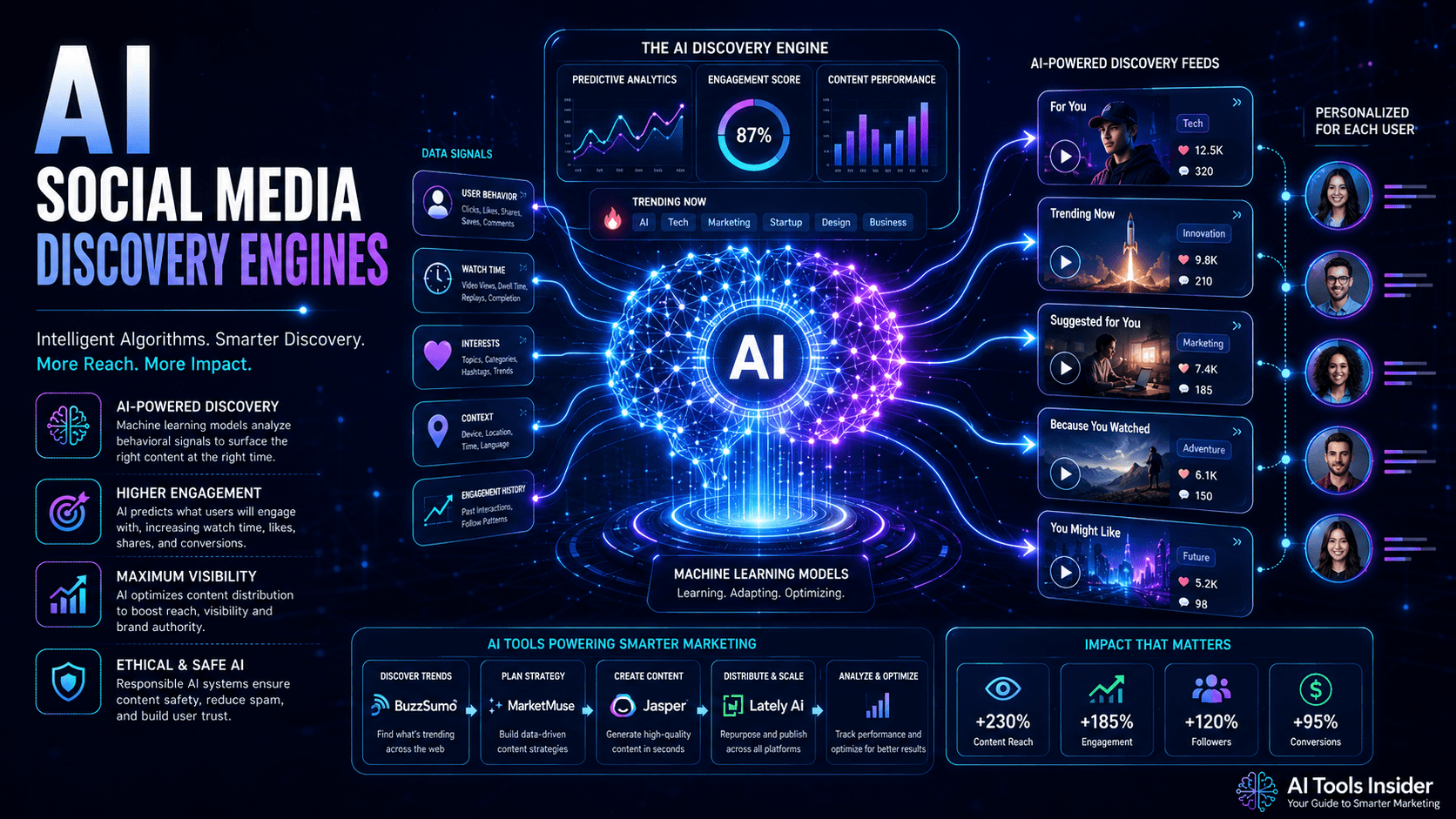
What Makes AI Social Media Discovery Engines Unique
Unlike traditional social media feeds, AI social media discovery systems prioritize relevance over timing. Instead of displaying content in chronological order, these systems use artificial intelligence to determine what users are most likely to engage with at any given moment. This shift has fundamentally changed how content is discovered and distributed across modern platforms.
Feed Algorithms
Traditional social feeds relied heavily on posting time and social connections. Modern discovery systems rank content based on predicted engagement, allowing highly relevant posts to reach large audiences regardless of when they were published. As a result, content quality and audience interest often have a greater impact on visibility than follower count alone.
Dynamic Social Graphs
Modern platforms no longer focus exclusively on friend networks and follower relationships. Instead, they build dynamic social graphs that map user interests, behaviors, and engagement patterns. This enables platforms to recommend content from creators users have never interacted with before, significantly expanding content discovery opportunities.
Personalization Loops
AI discovery systems continuously learn from user interactions. Every like, comment, share, save, replay, and scroll action provides feedback that helps the algorithm refine future recommendations. This creates a self-improving ecosystem where content recommendations become increasingly personalized over time. The more users engage with a platform, the more accurately the system understands their interests.
These characteristics explain why modern social media platforms function differently from traditional social networks. Visibility is no longer determined solely by who users follow but by how they interact with content across the platform. TikTok provides one of the clearest examples of this approach. Its algorithm can quickly identify niche interests based on user behavior and build highly personalized content feeds within a short period. This allows users to discover relevant content rapidly while giving creators the opportunity to reach new audiences without relying entirely on an existing follower base.
AI Social media discovery Engines and their Social Impact
AI social media discovery Engines influence more than entertainment and content recommendations. By determining what content users see, these systems play a significant role in shaping information flow, public awareness, and online behavior. Every day, discovery algorithms decide which conversations gain visibility, which topics trend, and which creators reach larger audiences. As a result, AI has become a powerful force in how information spreads across digital communities.
Content Moderation and Platform Safety
Modern social platforms use AI to identify and manage harmful content at scale. Systems deployed by platforms such as Facebook and X (Twitter) help detect:
- Harmful or abusive content
- Misinformation and misleading claims
- Spam and coordinated manipulation
By identifying problematic content more quickly, AI helps improve platform safety and maintain user trust. These systems also support healthier online environments by reducing the visibility of content that may negatively impact user experiences.
Promoting Social Awareness
AI discovery systems can also amplify valuable and informative content. Educational resources, public awareness campaigns, and important news stories often gain broader reach when algorithms identify strong engagement and relevance signals. This allows significant topics to spread more rapidly across audiences, helping users discover information they may not have actively searched for. In many cases, discovery engines serve as a bridge between content creators and individuals who share similar interests or concerns.
Cybersecurity and Ethical AI Use
Moreover, Artificial intelligence contributes to platform security by identifying unusual activity patterns that may indicate fraud, phishing attempts, fake accounts, or coordinated abuse. These systems help platforms respond more effectively to emerging threats and protect users from malicious activity.
At the same time, the growing influence of AI discovery engines raises important ethical considerations. Because algorithms play a major role in determining content visibility, platforms must balance personalization, transparency, user privacy, and content fairness. Responsible AI development is becoming increasingly important as social media platforms continue to shape how information is consumed worldwide.
As AI social media discovery engines become more advanced, their influence on public conversations, information access, and digital experiences will continue to grow. Understanding this impact is essential for marketers, creators, and businesses seeking to navigate an increasingly AI-driven online environment.
AI Tools for AI Social Media Discovery Engines
Marketers can leverage AI tools to align their content strategies with AI social media discovery systems and improve visibility, engagement, and distribution performance. These tools help bridge the gap between content creation and algorithm-driven discovery by improving how content is produced, optimized, and distributed.
Lately AI – Content Repurposing Engine
Lately AI transforms long-form content into multiple social media posts automatically, allowing marketers to extend the lifespan of a single piece of content across multiple platforms.
Key benefits include:
- Converts blogs, podcasts, and videos into social media posts
- Learns and adapts to brand tone and writing style
- Automates scheduling and distribution across platforms
For affiliate marketers, this means one high-quality article or video can be continuously recycled into algorithm-friendly content variations. Since discovery systems reward consistent engagement signals, this helps maintain visibility over time without constantly creating new content from scratch.
Jasper AI – Content Generation System
Jasper AI is an AI writing assistant used for marketing copy, social media content, and long-form articles.
Its core capabilities include:
- Social media captions, ad copy, and promotional content
- Blog posts and email marketing content
- Template-driven frameworks such as AIDA and PAS
Jasper helps marketers quickly generate multiple content variations, which is important in AI-driven platforms where testing different hooks, captions, and messaging styles can significantly impact engagement performance.
BuzzSumo – Trend Discovery Tool
BuzzSumo helps marketers identify what content is performing well across the internet by analyzing engagement patterns and viral topics.
It provides:
- Real-time viral topic tracking
- Competitor content analysis
- Engagement insights across platforms
- Influencer discovery and content amplification opportunities
For affiliate marketers, BuzzSumo is especially useful for identifying emerging topics before they peak. This allows content to be published early, increasing the chances of being picked up by discovery algorithms while competition is still low.
MarketMuse – Content Strategy AI
MarketMuse focuses on content planning, SEO strategy, and topic authority building.
It offers:
- Topic clustering for authority building
- Content gap analysis
- SERP competitiveness insights
- Strategic recommendations for content optimization
This ensures content is not only optimized for search engines but also structured in a way that aligns with user intent, increasing the likelihood of being surfaced by both search and social discovery systems.
How These Tools Work Together
When combined, these tools form a complete AI-powered content ecosystem that aligns with how modern discovery algorithms operate.
A typical workflow looks like this:
- BuzzSumo identifies trending topics and content gaps
- MarketMuse builds structured content strategy around those topics
- Jasper generates optimized content drafts and variations
- Lately AI distributes and repurposes content across multiple platforms
Together, they allow marketers to create a continuous content loop where ideas are discovered, structured, produced, and redistributed in a way that aligns with AI social media discovery engines.
This workflow is particularly powerful for affiliate marketers because it shifts content strategy from one-time publishing to ongoing algorithm-driven visibility optimization.
How Marketers Should Use AI Social Media Discovery Engines
To effectively compete in AI-driven social media environments, marketers need to align their content strategies with how discovery systems evaluate, rank, and distribute content. This requires a structured approach that focuses on trends, content architecture, engagement signals, and human oversight.
Step 1: Predict Trends Early
Use AI tools to identify topics before they reach peak popularity. Modern discovery systems reward early content adoption. When a topic is still emerging, competition is low and engagement signals are easier to capture. Content published at this stage has a higher chance of being amplified as the algorithm detects rising interest. By identifying trends early, marketers position their content within the initial growth phase of a topic, increasing the likelihood of visibility across recommendation feeds.
Step 2: Build Content Clusters
Group related topics into structured content ecosystems to improve authority and visibility. AI discovery systems often evaluate content not only individually but also in relation to surrounding content. Websites and creators that consistently publish related content signals stronger topical authority. Content clusters help platforms understand what a creator or brand specializes in, increasing the chances of being recommended to relevant audiences across multiple sessions and touchpoints.
Step 3: Optimize Engagement Signals
Use AI insights to improve timing, messaging, and content structure. Engagement signals such as watch time, saves, shares, and comments directly influence how discovery systems distribute content. Small improvements in hooks, captions, thumbnails, or posting time can significantly impact performance. Optimizing for engagement is not just about increasing likes, but about improving meaningful interactions that signal content value to the algorithm.
Step 4: Maintain Human Oversight
AI can handle scale and automation, but human input remains essential for long-term strategy.
While AI tools can generate content, identify trends, and optimize distribution, humans are responsible for maintaining:
- Consistent brand voice
- Ethical direction and messaging integrity
- Strategic decision-making aligned with business goals
This balance ensures that content remains authentic, trustworthy, and aligned with audience expectations, even in highly automated environments.
The Future of AI Social Media Discovery Engines
The future of social platforms is becoming increasingly AI-driven, with discovery systems evolving beyond simple recommendation engines into fully adaptive intelligence systems that shape how users interact with digital content. Instead of merely responding to user behavior, these systems are beginning to anticipate needs, preferences, and intent in real time.
Several key trends are already shaping this transformation.
Hyper-Personalized Feeds Powered by Generative AI
Future discovery systems will move beyond basic recommendation models into generative AI-driven personalization. Feeds will not only select existing content but also dynamically tailor how content is presented to individual users. This means two users may see completely different versions of the same platform experience, with AI adjusting layout, content sequencing, and recommendations based on deep behavioral patterns and predicted interests.
Interactive Content Experiences
Social platforms are increasingly shifting toward interactive formats such as polls, chat-based experiences, AI-generated media, and immersive content environments. These formats increase engagement depth, giving algorithms richer behavioral signals to analyze. As a result, discovery systems can better understand user intent and refine recommendations with greater accuracy.
Real-Time Content Adaptation
AI systems are becoming capable of adjusting content distribution in real time based on user interaction patterns. Instead of static ranking systems, platforms can now continuously recalibrate feeds as engagement signals change. This creates a dynamic environment where content performance can shift rapidly depending on early interaction signals such as watch time, retention, and engagement velocity.
Convergence of Search and Social Platforms
A major shift is the increasing integration between search engines and social media platforms. Social content is now being indexed and surfaced in search results, while search behavior is influencing social recommendations. This convergence means that discovery is no longer limited to one environment. Content visibility is now distributed across both search and social ecosystems, expanding the importance of optimization across multiple channels.
Overall, social platforms are evolving into intelligent systems that continuously learn from user behavior, refine content distribution, and shape digital experiences at scale. For marketers, this shift signals a future where success depends on understanding algorithmic behavior, user intent, and AI-driven content ecosystems rather than traditional posting strategies alone.
Conclusion
AI social media discovery systems have fundamentally changed how content is created, distributed, and consumed across modern platforms. Social media is no longer driven primarily by follower counts, chronological feeds, or direct social connections. Instead, visibility is now determined by machine learning systems that analyze user behavior, predict engagement, and continuously refine what content gets shown.
For marketers, this shift represents a major change in strategy. Success is no longer about simply posting content consistently, but about understanding how discovery algorithms evaluate signals such as watch time, engagement depth, content relevance, and user interaction patterns. Content that aligns with these signals has a significantly higher chance of being amplified across platforms.
AI tools now play a critical role in this ecosystem by helping marketers identify trends, generate content variations, optimize engagement, and scale distribution. However, while automation improves efficiency, human input remains essential for maintaining authenticity, brand identity, and long-term strategic direction.
The future of social media will continue to move toward more intelligent, predictive, and personalized systems. As these platforms evolve, marketers who understand AI-driven discovery and adapt their content strategies accordingly will be better positioned to build visibility, authority, and sustainable growth in an increasingly algorithm-driven digital landscape.