
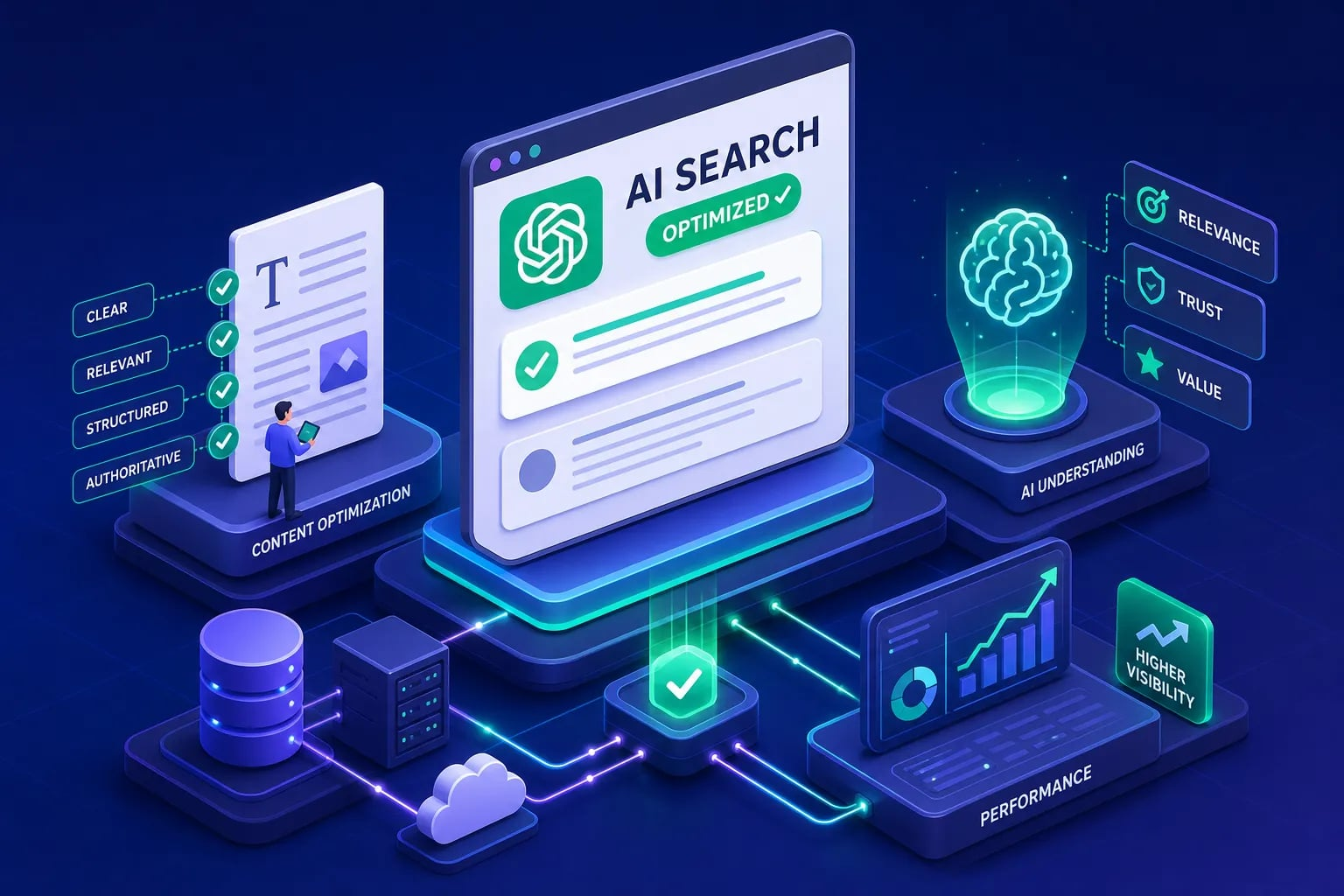
How to Optimize Your Content for ChatGPT Search
Ranking on Google and getting cited by ChatGPT Search are two different problems. To optimize for ChatGPT search, you need to structure pages so individual passages can be lifted out and used as direct citations without losing meaning. Your affiliate content can sit on page one of Google and still not appear in a single ChatGPT answer. We’re seeing this play out in our own traffic data at AIToolsDigest, and most affiliate marketers haven’t figured out why the two systems behave so differently.
The core difference is selection logic. Google’s system historically emphasizes authority signals that accumulate over time, backlinks, domain age, engagement patterns. ChatGPT Search selects pages that materially support a specific claim in a generated answer and can be read clearly at the passage level. Meta descriptions are not a known citation signal for ChatGPT Search. Neither does your backlink profile, on its own. What matters is whether your content can be lifted out of context and used as a direct citation without losing its meaning.
We have been tracking how ChatGPT, Gemini, and Perplexity pull and cite affiliate content since these tools shifted from novelty to primary search behavior. Specifically, we log citation appearances, referral sessions, and passage-level extraction patterns across our own published pages. The traffic patterns AI systems create, including clickless citations and passage-level selection, don’t follow traditional SEO logic, and the fixes aren’t complicated. By the end of this guide, you’ll have a concrete checklist you can apply to your existing pages without rebuilding anything from scratch.
How ChatGPT picks sources (and why it’s not a ranking algorithm)
OpenAI has not published a fixed ranking formula for ChatGPT Search. What’s documented through official statements and observable behavior comes down to four factors: query-level relevance, source reliability and authority, content freshness for time-sensitive queries, and page extractability. That last one is where many affiliate sites fall short, because it’s the furthest from anything traditional SEO training covers.
A page doesn’t get cited because it ranks on page one. It gets cited because it directly supports a claim in the generated answer and can be parsed at the passage level. ChatGPT doesn’t read your full article the way a human does. It retrieves passage-level content, evaluates whether that passage answers the specific sub-query it’s working on, and cites accordingly. A page with strong domain authority but vague, narrative-heavy copy loses to a newer page with a clean, direct answer block. This is the foundation of LLM content optimization, and it’s what most AI answer optimization guides underemphasize.
What “extractability” actually means for affiliate pages
Extractability is simple: can a single paragraph from your page be pulled out and used as a citation without losing its meaning? Pages that get cited most consistently share a clear pattern. The direct answer appears near the top, paragraphs are short and self-contained, and each section addresses exactly one user question. Long intro sections, vague affiliate filler copy, and “stay tuned because we’ll cover that later” writing actively hurt this signal. Every paragraph should be able to stand on its own.
The crawl access prerequisite most affiliates skip
Before anything else, check whether OAI-SearchBot is blocked in your robots.txt file. If it is, your page will not appear in ChatGPT Search results regardless of how good the content is. (Sites that block OAI-SearchBot may still surface as navigational links in limited contexts, but they won’t be pulled as answer citations.) This is the baseline requirement, not an optimization advantage. Allowing crawl access doesn’t guarantee citation, but blocking it guarantees exclusion from answers. Fix this first, then work on everything else.
How to optimize for ChatGPT search: structuring pages for LLM extraction
Affiliate content is typically written for engagement and conversion. Narrative build-up, storytelling, personality-driven intros: these serve human readers well. They also work against LLM citation patterns. The fix isn’t to strip the personality out of your writing. Lead with the answer and layer in the reasoning after, rather than building up to the conclusion at the end. That single structural shift does more for ChatGPT search optimization than most technical changes.
Answer-first writing to optimize for ChatGPT search
Each section heading should reflect the user’s actual question, and the first sentence of that section should directly resolve it. The pattern: heading frames the question, opening sentence delivers the answer, the next two or three sentences add context or evidence. Consider a typical affiliate product review section. Instead of opening with “When we first started testing this tool, we noticed a lot of interesting things,” write “This tool is the stronger choice for affiliate keyword research because it surfaces low-competition clusters that most other platforms miss.” That first sentence can be cited. The original version cannot.
Heading architecture that maps to user intent
Build your heading hierarchy around intent-shaped questions rather than creative labels. H2s for major questions, H3s for narrower follow-ups. A heading like “What is the best AI keyword tool for affiliate sites?” outperforms “Our top picks” because it matches how users actually query AI assistants. When ChatGPT receives that same question, it scans for pages with answer blocks that correspond to the query. Research on passage-level citation patterns suggests aiming for roughly 40 to 75 words per standalone answer block under each major heading, enough to be useful as a citation without being too dense to extract cleanly.
Keeping content blocks self-contained
Each paragraph should work if lifted out of context. That means no vague references like “as mentioned above” or “this tool” without naming the tool. State the entity, state the claim, include the qualifier. For comparison sections and step-by-step guides, numbered lists and tables expose structured facts in formats LLMs can parse and re-present accurately, which is why Wikipedia and G2-style comparison pages get cited so frequently for commercial queries.
Schema markup and entity signals: what to implement first
Structured data is a hygiene factor, not a citation trigger. That’s the honest framing, and it matters because a lot of Generative Engine Optimization (GEO) advice overstates what schema can do. Schema helps AI systems disambiguate who produced the content, what the page is about, and whether the author and publisher can be verified. Missing it creates unnecessary ambiguity that works against affiliate sites already competing against more established publishers.
The priority markup stack for affiliate content
Start with Organization, Person, and Article or BlogPosting as the foundation. This combination establishes who published the content, who wrote it, and what the page covers. For the Article markup, the fields that matter most are headline, author, publisher, datePublished, and dateModified. Connect these entities using stable @id values in JSON-LD so AI systems can trace the relationship between the author, the publisher, and the content. FAQPage and HowTo only get added when the page genuinely contains those content types. Adding FAQPage markup to a page without real user-facing FAQs doesn’t help and may create inconsistencies that undermine trust signals.
Review and comparison pages use Product or SoftwareApplication markup with factual specifications and availability information. SoftwareApplication specifically prioritizes the applicationCategory, operatingSystem, and offers fields, these give AI systems the structured facts most likely to appear in commercial query answers. For affiliate sites covering AI tools, this markup can be especially helpful for visibility in product-focused results.
Signaling authorship and organizational identity
The sameAs property is particularly useful for solo affiliate publishers because it helps corroborate identity outside your own domain. Linking your Organization and Person entities to LinkedIn profiles, social accounts, and author pages gives AI systems verifying signals they can cross-reference. Your About page and author profile page are priority targets for this markup, not just individual articles. A standalone article with Article schema but no verifiable author entity behind it carries less weight than the same article connected to a Person entity with external corroboration.
Building the kind of citation authority AI assistants actually trust
Topical depth separates sites that get cited consistently from sites that get cited occasionally. ChatGPT Search favors pages from sources that demonstrate subject-matter authority, and for affiliate sites, that authority comes from consistent, credible coverage of a specific topic cluster rather than broad-topic generalism. A single excellent page on AI keyword research tools might earn citations for that specific query. A site with ten deeply connected pages covering the same topic cluster earns citations across many query variations.
Based on our ongoing tracking at AIToolsDigest, publications that build dense topical coverage around AI tools and affiliate marketing workflows appear more consistently in ChatGPT and Perplexity answers than one-off review sites that publish a single product comparison and move on. This observation is based on logged citation appearances across our own content and peer sites we monitor, not a controlled study, but the pattern is consistent enough to shape our editorial strategy. Pick your niche cluster and go deep. Shallow pages at scale dilute topical authority; comprehensive coverage within a defined subject builds it.
External linking strategy for credibility signals
Affiliate content that links out to primary sources, published studies, and official documentation reads more credibly to AI citation systems than content that only links internally or to affiliate programs. Every factual claim gets a source. Even if that source belongs to a competitor or a neutral third party, the signal you’re sending is “this site verifies what it says.” That’s a trust signal AI systems can evaluate, and it’s one most affiliate content skips entirely because the instinct is to keep readers on-site.
Internal linking and topical map building
Tightly linked clusters of related content function as an authority signal in their own right. A standalone product review page is harder to cite than a review page connected to a comparison guide, a use-case tutorial, and a keyword research walkthrough covering the same tool. Build a topical map rather than isolated pages. When AI systems retrieve content on a topic, they don’t just evaluate the page you’re hoping gets cited. They evaluate the broader evidence that your site is a coherent authority on the subject.
Measuring traffic and visibility from ChatGPT Search
Web analytics can capture a real portion of AI-driven traffic, but not all of it. Some of your biggest citation wins will generate brand recognition and zero referral sessions, because users read the answer in ChatGPT and don’t click through. Set that expectation before you start reporting, so you’re not drawing false conclusions from incomplete data.
GA4 configuration for AI referral traffic
In GA4, create a custom channel group that classifies known AI domains as an “AI traffic” segment. The primary referrer domains to monitor are chatgpt.com, chat.openai.com, perplexity.ai, gemini.google.com, claude.ai, and copilot.microsoft.com. Place the ChatGPT Search channel above Referral, Organic Search, and Direct in the channel order, because GA4 evaluates rules from top to bottom and you don’t want qualifying sessions absorbed by a broader channel.
For controlled placements, use a consistent UTM convention: utm_source=chatgpt, utm_medium=ai_referral, and a campaign identifier tied to the topic cluster. Then apply the AI segment to your conversion reporting and compare AI session quality against organic search benchmarks using the same attribution model.
Tracking citations that don’t produce clicks
Clicks are only part of the picture, and for brand-awareness citations they’re often a small part. Run scheduled manual prompt tests across ChatGPT, Gemini, and Perplexity for your target queries and log the results. Set up brand mention monitoring to catch references you’re not actively testing for. Add a simple “how did you hear about us?” form field on your lead capture pages with AI assistant as one of the options. Report three separate numbers: confirmed AI traffic (sessions with an AI referrer or UTM), AI-assisted conversions (conversions where AI appeared anywhere in the customer journey), and estimated AI influence (survey responses and citation visibility). Blending these into one number overstates what analytics can prove and understates the full effect.
The checklist, in plain terms
None of this requires a platform migration or a technical team. It requires changing how you write and how you verify what you publish. Here’s the short version.
- Allow OAI-SearchBot in your robots.txt file
- Restructure pages for answer-first extraction: heading frames the question, first sentence delivers the answer
- Keep paragraphs self-contained; name entities explicitly instead of using vague references
- Implement Organization, Person, and Article schema with proper entity connections via JSON-LD
- Link out to primary sources for every factual claim
- Build topical depth over breadth through interconnected content clusters
- Set up GA4 with a custom AI channel group and track citations that don’t produce clicks separately
Affiliate marketers who treat ChatGPT search optimization as a separate discipline from Google SEO are reporting real differences in their traffic and referral patterns. Those treating it as the same game keep wondering where their referrals went. AIToolsDigest continues to track how these AI search platforms evolve and what that means for affiliate revenue. This is a structural change in how search works, and the sites adapting to it now are building an advantage that won’t be easy to close later.


