
AI Workflow Automation for Affiliate Marketing
tooIntroduction
AI workflow automation for affiliate marketing has changed how teams handle repetitive tasks across affiliate campaigns. Affiliate marketing involves numerous recurring activities, from keyword research and content drafting to formatting SEO tags, scheduling social media posts, updating affiliate links, and tracking performance metrics. Handling these tasks manually can create operational difficulties. Campaigns take longer to launch, data gets trapped in silos, and marketers spend valuable time copy-pasting instead of focusing on higher-level growth activities.
It connects these activities into a structured process where software can trigger tasks, process information, and move outputs from one stage to the next. Instead of doing keyword research, content creation, optimization, distribution, and performance tracking as isolated activities, marketers can build workflows that connect them. AI can handle predictable tasks, while humans stay focused on strategy, quality control, and decisions that require context and judgment. This article explores how AI workflow automation works in affiliate marketing, the tasks to be automated, how to build effective workflows, and where human input remains essential.
What is AI Workflow Automation for Affiliate Marketing?
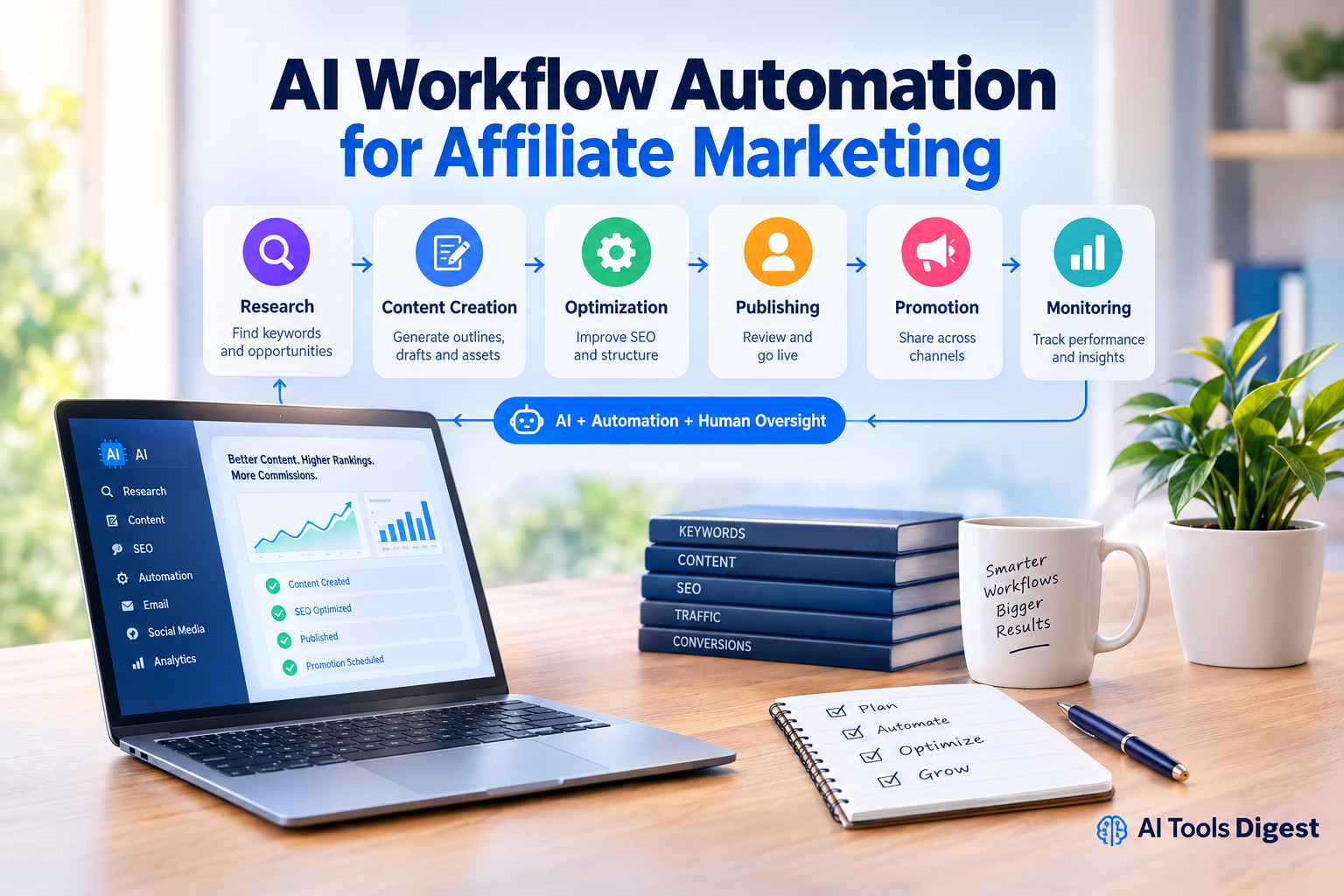
AI workflow automation for affiliate marketing uses AI tools and automation software to execute and coordinate a series of connected marketing tasks. Rather than using AI as a standalone assistant for individual tasks, an automation workflow links multiple steps so the output from one task feeds into the next. For example, a workflow can begin with keyword research, content planning and creation, then SEO optimization and publishing, and extend to promotion and performance monitoring.
Using an AI tool for a single task differs from automating a workflow. Asking an AI tool to generate a content brief completes a single task but does not determine what happens afterward. A workflow can connect that brief to subsequent processes, such as generating a draft, sending it for review, publishing the finished article, and recording its performance. Automation software can trigger these actions or transfer information between tools, while AI handles tasks that require content generation, analysis, classification, or other forms of processing.
A typical affiliate marketing workflow follows a sequence such as:
Research → Content → Optimization → Publishing → Promotion → Monitoring
The level of automation can vary at each stage. Some tasks run automatically through predefined triggers, while others may require human approval before the workflow continues. This combination allows AI to handle predictable or data-intensive activities without removing human oversight from decisions that require strategy, judgment, or quality control.
Why Use AI Workflow Automation in Affiliate Marketing?
AI workflow automation can reduce the amount of manual coordination required to manage repetitive affiliate marketing activities. By connecting related tasks, marketers can move information between campaign stages without repeating the same actions or manually transferring data. The benefits of AI workflow automation in affiliate marketing include:
Reducing repetitive manual work
Tasks such as research, content brief generation, content formatting, post scheduling, and performance data compilation can follow predefined, automation-ready processes. Automating these tasks speeds up content and campaign workflows, allowing completed outputs to move to the next stage with less manual intervention.
Improving consistency across repetitive tasks
Once a workflow is configured, you can apply the same rules and processes each time a task starts. Moreover, connecting different marketing activities reduces the need to manage each process independently, creating a more structured workflow from research through performance monitoring.
Scaling content and marketing activities without duplicating every manual step
As affiliate operations grow, connected workflows increase output without proportionally increasing manual work. Instead of repeating the same steps for every new campaign or content asset, marketers can automate predictable processes while retaining control over important decisions. This creates more time to strategise, analyse performance, review content, and handle other activities that require human intervention.
AI can automate and assist with several stages of an affiliate marketing workflow, from researching content opportunities to monitoring campaign performance. However, the level of automation varies by task. Some activities can run largely through predefined workflows, while others still require human review and decision-making.
What Affiliate Marketing Tasks Can AI Automate?
Keyword and Topic Research
AI supports the early stages of affiliate content research by generating topic ideas, conducting keyword clustering and identifying content opportunities. Additionally, it turns research data into structured content briefs, reducing information organization before manual content production begins. Automation can connect these research activities to subsequent stages of the workflow. For example, AI can complete a keyword research task, trigger a content brief, or send research data to another tool for further processing. Human input plays an important role in evaluating search intent, commercial relevance, and whether a topic is worth pursuing.
Content Planning and Creation
Content planning and creation processes, including generating outlines, developing content briefs, producing first drafts, and repurposing existing content, can use AI. Also, AI creates supporting content around commercial pages, such as comparison articles, informational guides, and related content. These tasks connect through an automated workflow, so information generated at one stage becomes input for the next. For example, a content brief can trigger draft generation before the article moves to editing or approval. Verification is crucial to maintain editorial quality and ensure the content meets the desired requirements.
SEO and Content Optimization
AI can help analyze content structure and identify areas for optimization. Depending on the tools, workflows can help identify missing topics or entities, generate metadata, suggest internal linking opportunities, and improve content organization. These optimization tasks form part of a content workflow after generating a draft. An automated process sends the complete content for analysis with recommendations before publication. However, optimization suggestions require evaluation to determine how they improve the content rather than adding changes for the sake of optimization.
Affiliate Content Distribution
Affiliate marketers can use AI to automate the adaptation of published content for different distribution channels. For instance, a single article can become social media posts, promotional copy, or shorter content formats. Automation schedules and distributes these assets according to predefined rules. This reduces the need to recreate and publish promotional content for every channel manually. Human oversight remains useful for reviewing messaging, maintaining consistency, and deciding which content is appropriate for each platform.
Email Marketing Workflows
AI can assist with recurring email marketing activities by generating email variations, repurposing published content into newsletters, and helping organize audience segments. These activities can connect to automated sequences that trigger follow-up emails based on predefined conditions or subscriber actions. For example, a newly published affiliate article could trigger a newsletter draft, which then goes for approval before distribution. The automation moves it between stages, while human input determines the messaging, audience, timing, and final content.
Performance Monitoring
Moreover, AI helps monitor the performance of affiliate marketing activities by collecting campaign data, summarizing results, identifying unusual changes, and generating recurring reports. Instead of manually gathering information from multiple platforms, an automated workflow can collect relevant data and organize it into a consistent reporting process. It analyzes the collected information and highlights patterns or changes that may require attention. However, identifying a change is different from determining its cause or deciding what action to take. Performance analysis and strategic decisions therefore remain areas where human judgment is important.
How to Build an AI Workflow for Affiliate Marketing
Building an AI workflow for affiliate marketing involves identifying repetitive processes, connecting the tools involved, and defining what should happen at each stage. The goal is not to automate every activity, but to create a process where predictable tasks can move forward with minimal manual intervention while important decisions remain under human control.
Identify Repetitive Tasks
Begin by identifying tasks that teams perform frequently and that follow a relatively predictable process. Keyword research, content brief creation, content formatting, social media scheduling, and performance reporting are activities that may be suitable for automation. Tasks that require strategic judgment or extensive context may be better handled manually or kept as approval points within the workflow.
Map the Workflow
After identifying the repetitive tasks, map how information moves between them. Define the starting point, the actions, and the output at each stage. For example, a content workflow could begin when a new keyword opportunity is identified, followed by research, brief creation, content production, optimization, review, publishing, and promotion. Mapping these steps makes it easier to determine which activities can be automated and where human input is required.
Choose the AI and Automation Tools
Different stages of an affiliate workflow may require different tools. An AI writing platform can handle content generation, an SEO tool can analyze optimization opportunities, and an automation platform can connect these applications and trigger actions between them. The tools should therefore be selected according to the requirements of the workflow rather than trying to find a single platform that performs every task.
Define Triggers and Actions
Automation depends on clearly defined triggers and actions. A trigger starts a workflow, while an action determines what happens next. For instance, adding a new topic to a content database could trigger AI-generated research or a content brief. Once the brief is complete, another action could send it to a writing tool or notify an editor for review. Clearly defining these conditions helps prevent workflows from running unnecessarily or producing incomplete outputs.
Add Human Review
Not every stage should run automatically. Human review can be added wherever accuracy, context, strategy, or editorial judgment is required. For affiliate content, this may include reviewing research, checking factual claims, evaluating product information, editing AI-generated content, and approving material before publication. The workflow can pause at these stages until the required approval is provided.
Test and Refine the Workflow
An automation workflow should be tested before being used at scale. A workflow may fail because information is incomplete, a tool produces an unexpected output, or an action does not trigger as intended. Testing individual stages helps identify these problems before they affect multiple campaigns or content assets. Once the workflow operates reliably, its rules, prompts, and automation conditions can be refined as requirements change.
Example of an AI Affiliate Marketing Workflow
A practical AI workflow can connect several affiliate marketing tasks around a single piece of content. Considering an affiliate marketer publishing product-focused content, automation moves an article from initial research through promotion and performance monitoring.
Research
An automation workflow begins with a keyword, topic, or content opportunity. AI analyzes the available research, identifies related topics, organizes keywords, and helps develop a content brief. Once the research stage is complete, the resulting information can move to the next stage of the workflow.
Content Creation
The content brief is used to generate an outline and the first draft. AI can assist with structuring the article, developing sections, and incorporating information from the research stage. The complete draft then goes to an editor or moves into an optimization workflow.
Optimization
An SEO or content optimization tool can analyze the draft for issues such as missing topics, metadata, content structure, or internal linking opportunities. The workflow can generate recommendations or apply predefined changes before the content moves to review.
Human Review and Publishing
Before publication, reviewing the content for accuracy, originality, affiliate disclosures, product claims, and overall quality is important. Once approved, the article can move to automatic publication or scheduled publication through the site’s content management system.
Promotion
After publication, the workflow can trigger the creation of promotional assets. AI can repurpose the article into social media posts, email content, or other short-form formats. These assets can then be scheduled for distribution across the relevant channels.
Performance Monitoring
The workflow can continue after publication by collecting performance data from analytics and marketing platforms. AI can summarize traffic, engagement, conversions, or other relevant metrics and generate recurring reports. Significant changes can also trigger alerts for further investigation. The result is a connected process:
Research → Content Creation → Optimization → Human Review → Publishing → Promotion → Monitoring
Each stage performs a specific function, while automation moves information between stages. AI handles tasks involving content generation and analysis, automation software coordinates the workflow, and human input remains responsible for decisions that require judgment and context.
Affiliate Marketing Workflow Automation AI Tools
AI workflow automation typically involves more than one tool because different stages of an affiliate marketing process require different capabilities. Some tools focus on AI-assisted content creation or analysis, while automation platforms connect applications and move information between them.
AI Content and Writing Tools
AI writing tools can assist with content briefs, outlines, first drafts, content repurposing, and other writing tasks. They are particularly useful when content production is one of the most time-consuming stages of an affiliate workflow. However, generating content is only one part of an automated workflow. The output may need to pass through optimization, review, publishing, and distribution stages before the workflow is complete.
SEO and Content Optimization Tools
SEO tools can support keyword analysis, content optimization, metadata generation, internal linking, and other search-related tasks. When connected to an automation workflow, these tools can analyze content after creation and provide recommendations before publication. The level of automation depends on the tool. Some platforms primarily provide recommendations, while others can perform changes or integrate with other applications.
Automation Platforms
These platforms connect different applications and define what happens when specific events occur. A trigger might be the creation of a new content brief, publication of an article, or addition of a new performance record. The platform can then pass information to another application, trigger an AI task, send a notification, or update a database. This connecting layer is what turns individual AI capabilities into a broader workflow.
Email and Distribution Tools
Email marketing and social media platforms can connect to workflows for content distribution. AI can generate or adapt promotional content, while automation can schedule messages, trigger sequences, or distribute content when predefined conditions are met.
Analytics and Reporting Tools
These tools provide the performance data needed to evaluate affiliate campaigns. Automation can collect and organize this information, while AI can summarize trends, highlight significant changes, and generate recurring reports. Together, these tools can form a connected system rather than isolated applications. The appropriate combination depends on the affiliate marketer’s workflow, existing technology stack, and the level of automation required.
What AI Workflow Automation Cannot Do
This section is important for credibility.
- Strategic decision-making still requires human judgment
- AI-generated content requires review
- Automated workflows can propagate errors
- Search and affiliate compliance still need attention
- AI cannot guarantee rankings, traffic, or conversions
- Automation can create inefficient processes if the underlying workflow is poorly designed
AI Automation vs Human Control in Affiliate Marketing
AI workflow automation can handle many repetitive and data-intensive activities, but it does not eliminate the need for human involvement. Different stages of an affiliate marketing workflow require different levels of automation and judgment.
| Workflow Area | AI/Automation Role | Human Role |
|---|---|---|
| Research | Analyze and organize information | Validate opportunities |
| Content | Draft and structure content | Edit and fact-check |
| SEO | Identify optimization opportunities | Make strategic decisions |
| Distribution | Repurpose and schedule content | Approve messaging |
| Analytics | Summarize and organize data | Interpret performance |
| Strategy | Provide insights and identify patterns | Make decisions |
The distinction is important because automation works best when applied to predictable processes, while human input remains necessary for decisions that require context, judgment, and accountability. A well-designed affiliate marketing workflow therefore combines automated execution with human oversight rather than attempting to automate every stage.
Frequently Asked Questions
Can AI be used for workflow automation?
Yes. AI can be incorporated into automated workflows to handle tasks such as research, content generation, analysis, classification, and content repurposing. Automation software can then connect these tasks, transfer information between applications, and trigger subsequent actions based on predefined conditions. The level of automation depends on the task and the tools being used.
What AI tools can automate affiliate marketing?
Different tools can automate different parts of an affiliate marketing workflow. AI writing tools can assist with content creation, SEO platforms can support optimization, automation platforms can connect applications, and analytics tools can help monitor performance. The appropriate tools depend on which parts of the workflow need to be automated.
Are there free AI tools for affiliate marketing?
Yes. Some AI and automation tools offer free plans or limited free usage that can support activities such as content ideation, research, writing, and basic workflow automation. Free plans often have restrictions on features, usage, integrations, or task limits, so the suitability of a free tool depends on the requirements of the workflow.
How much of affiliate marketing can be automated?
A significant portion of repetitive affiliate marketing tasks can be automated or AI-assisted, including research organization, content drafting, content repurposing, scheduling, data collection, and reporting. However, activities involving strategy, fact-checking, editorial judgment, compliance, and performance interpretation generally require human involvement. The practical goal is therefore to automate predictable processes while retaining human control over important decisions.
Conclusion
AI workflow automation can connect repetitive affiliate marketing tasks into a more structured and efficient process. From research and content creation to optimization, distribution, and performance monitoring, AI can assist with or automate predictable activities across the workflow.
The value of automation, however, does not come from simply adding more AI tools. It comes from connecting the right tasks, defining how information moves between them, and determining where human review is required. Strategic decisions, fact-checking, editorial judgment, and performance interpretation still require human involvement.
For affiliate marketers, a practical approach is to start with one repetitive process, automate the predictable steps, and refine the workflow based on its results. The goal is not to automate affiliate marketing completely, but to build a system where AI handles repetitive execution while marketers remain in control of strategy, quality, and growth.


